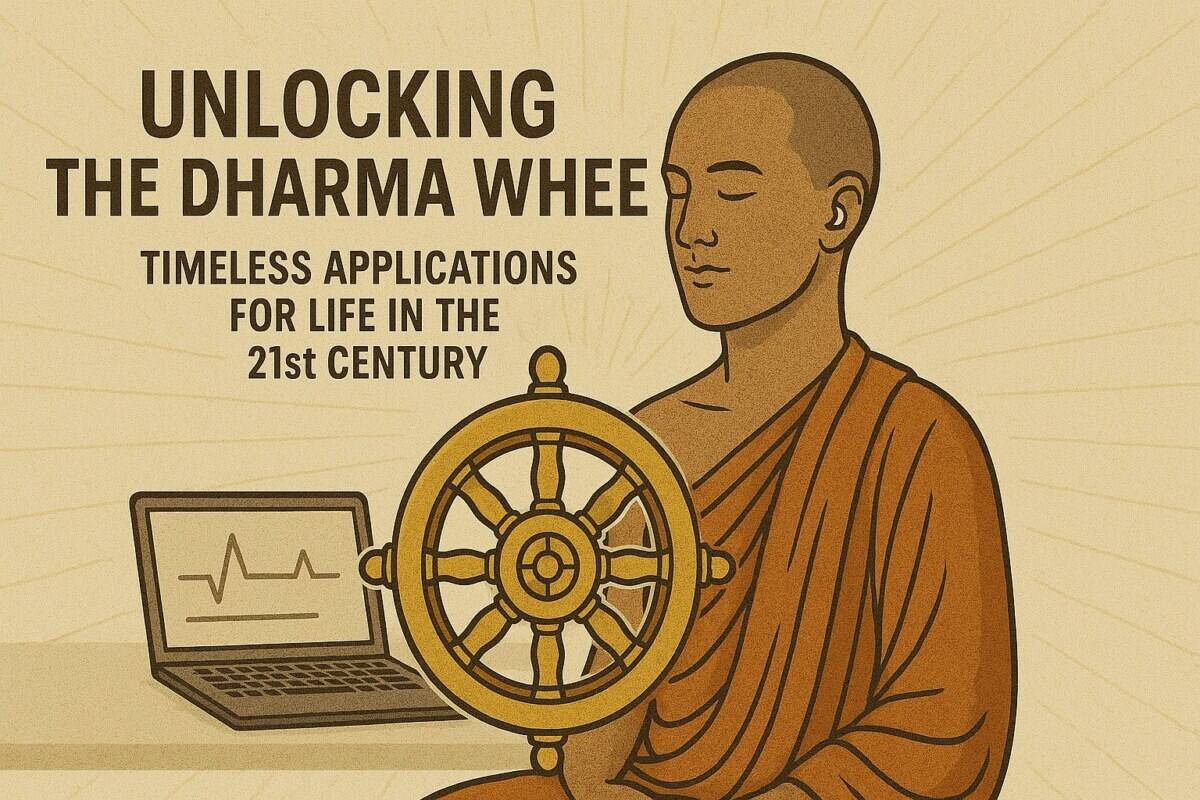
Unlocking the Dharma Wheel: Timeless Applications for Life in the 21st Century
In an age of digital noise, moral gray zones, and global unease, something deep inside us still longs for direction—an inner compass that points to truth.
Enter: the Dharma Wheel.
Also known as the Dharmachakra, this sacred symbol is far more than a Buddhist emblem. It’s a universal map of alignment—linking consciousness, conduct, and cosmic law. For over 3,000 years, it has quietly guided seekers, sages, and civilizations toward a more centered, ethical, and awakened life.
Though it’s most often associated with the Buddha, the Dharma Wheel’s roots run deeper—emerging from the Vedic hymns of ancient India, and possibly even earlier from sun-symbols found in the Indus Valley Civilization.
So… what does it really mean?
And more importantly—how can it help us navigate the complexity of the 21st century?
In this article, we’ll decode the Dharma Wheel’s hidden geometry, explore the meaning of its spokes, rim, and hub, trace its symbolic evolution across history—and show how it can become a powerful guide for your modern life.
Because this isn’t just about ancient philosophy.
It’s about you—your values, your path, your power to turn inward and lead with clarity.
🔄 Let’s turn the wheel—together—and rediscover the wisdom at its center.
Watch the breakdown: This 5-minute video sets the tone for everything that follows.
Why the Dharma Wheel Still Matters in a Fractured World
In a world flooded with distraction, division, and disconnection, we’re quietly craving something deeper—
Not more noise, but meaning.
Not more speed, but center.
Not more control, but clarity.
Amid the turbulence of modern life, an ancient symbol quietly offers us a map back to alignment:
🌀 The Dharma Wheel.
Also known as the Dharmachakra, this sacred wheel is far more than a religious icon.
It’s a civilizational compass—a symbol of truth in motion, of ethics in action, of consciousness turning toward liberation.
While it’s most often associated with the Buddha, the Dharma Wheel’s roots reach deeper—into the Rig Veda, into the solar seals of the Indus Valley, into the original rhythms of time, nature, and moral law.
And somehow, over 3,000 years later, it still speaks to the questions we’re asking now:
How do I live with purpose in a chaotic world?
What does it mean to be ethical when systems reward selfishness?
Is there a timeless center I can return to—inside myself?
The Dharma Wheel answers not with dogma, but with design.
And its wisdom is more relevant now than ever.
What Is the Dharma Wheel? [Simple Definition]
The Dharma Wheel—or Dharmachakra—is an ancient symbol from Indian spiritual traditions that represents:
- Dharma (truth, cosmic order, right action)
- The path to awakening
- The continuous cycle of existence and liberation
At its core, the wheel consists of:
- A hub, symbolizing centeredness and moral discipline
- Spokes, representing principles like the Eightfold Path or Four Noble Truths
- A rim, reflecting mindfulness and wholeness that holds everything together
While originally rooted in Vedic and Buddhist cosmology, the Dharma Wheel has evolved into a universal icon of inner alignment, ethical living, and spiritual momentum.
It’s not just a symbol.
It’s a system—for living in harmony with yourself, others, and the universe.
The Ancient Origins of the Dharma Wheel
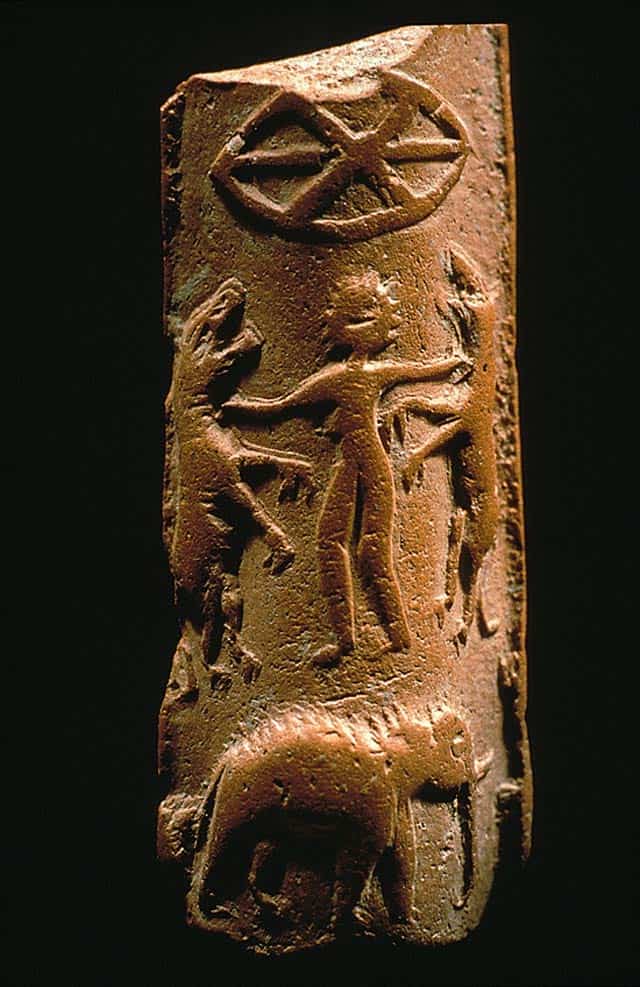
The Dharma Wheel—or Dharmachakra in Sanskrit—is one of humanity’s oldest known spiritual symbols. While today it’s closely associated with Buddhism, the truth is much deeper: this powerful emblem of inner and outer order was already ancient by the time of the Buddha.
🔍 Origins in the Indus Valley (c. 2500 BCE)
Archaeological discoveries from the Indus Valley Civilization—particularly at sites like Mohenjo-Daro and Harappa—reveal circular motifs and sun-like seals dating back over 4,000 years (Possehl, 2002).
These early images likely symbolized solar power, cyclical time, and divine order—core ideas that later evolved into the concept of dharma. Though they weren’t called “Dharma Wheels” at the time, their form and meaning laid the foundation for what would become one of the most important sacred symbols in Indian and Eastern spiritual philosophy.
📜 The Vedas and the Cosmic Law of Dharma (~1300 BCE)
The word “dharma” first appears in the Rig Veda, composed around 1500–1200 BCE. In this early context, it referred to cosmic law and natural order—the force that holds the universe together and keeps society from falling into chaos (Jamison & Brereton, 2014).
Dharma wasn’t a religion or a rigid moral code. It was something much bigger: a principle of balance between nature, humanity, and the cosmos—what later Hindu texts would call Ṛta, or the underlying rhythm of all existence.
The wheel began symbolizing this idea: a continuous, perfect cycle without beginning or end, representing both the passage of time and the eternal truth beneath it.
🧘 The Buddha’s Contribution (~500 BCE): Turning the Wheel
When Gautama Buddha began his teachings in the 5th century BCE, he didn’t invent the Dharma Wheel—he revived and reinterpreted it.
The Buddha’s first sermon, delivered at Sarnath, is called the Dhammacakkappavattana Sutta—literally, “Setting the Wheel of Dharma in Motion.” In this moment, the symbol took on a new layer: it now represented ethical living, conscious awakening, and liberation from suffering (Bhikkhu Bodhi, The Noble Eightfold Path).
Rather than just symbolizing cosmic order, the wheel became a practical path to inner freedom.
From that point forward, the Dharmachakra came to represent the Buddha’s teachings, especially the Four Noble Truths and the Noble Eightfold Path—each often visualized as spokes in the wheel.
🌞 A Universal Symbol Across Time
As centuries passed, the Dharma Wheel took on deeper and more layered meanings:
- In Hinduism, it remained tied to the sun god Surya, who rides a chariot with a single wheel through the sky—an ancient metaphor for time and cosmic order (Puranas, Vishnu Purana, ~400 CE).
- In Buddhism, the wheel became a visual shorthand for the path to enlightenment and the Buddha’s presence in all directions of space and time.
- In modern India, the Ashoka Chakra—a 24-spoke Dharma Wheel—is enshrined in the national flag, representing justice, progress, and moral leadership, as envisioned by Mahatma Gandhi (India Ministry of Culture).
The Dharma Wheel: More Than a Buddhist Symbol
The Dharma Wheel isn’t just a Buddhist icon—it’s a civilizational blueprint.
Long before it became the emblem of the Buddha’s teachings, this sacred wheel encoded universal principles: truth, balance, rhythm, and right action.
From the sun-disc seals of the Indus Valley,
to the Ṛta hymns of the Vedas,
to the Eightfold Path of Buddhism,
the wheel has always pointed in one direction—
→ Toward alignment with natural law, inner peace, and cosmic order.
It is not just a symbol of religion.
It is a symbol of remembrance—that even across thousands of years and civilizations, we’ve been asking the same question:
How do we live in harmony with the truth?
The Dharma Wheel is that answer—etched in stone, encoded in scripture, and still turning today.
What Does The Wheel Of Dharma Symbolize
A Symbol of Moral Revolution
This version of the Dharma Wheel was popularized by Emperor Ashoka in the 3rd century BCE, one of India’s greatest rulers. After witnessing the bloodshed of the Kalinga war, Ashoka embraced nonviolence, spiritual duty, and ethical governance. He used the wheel to represent:
- Justice
- Peace
- Moral progress through dharma
Later, Mahatma Gandhi adopted the Ashoka Chakra as a central symbol of India’s independence movement. For Gandhi, it stood for a new India led by moral courage, inner truth, and service to others—not by military power, but by conscious evolution
(India Ministry of Culture).
The Ashoka Chakra became the centerpiece of India’s flag in 1947, symbolizing a rebirth into ethical sovereignty.
Sanskrit Meaning and Universal Ideal
In Sanskrit:
- Ashoka = “Without sorrow”
- Chakra = “Wheel”
Together, they translate to: “The wheel without sorrow.”
The message? That a life rooted in dharma leads to liberation from pain—not through escape, but through conscious alignment with truth and compassion.
☀️ 1. The Dharma Wheel as the Sun (Indus Valley Origins)
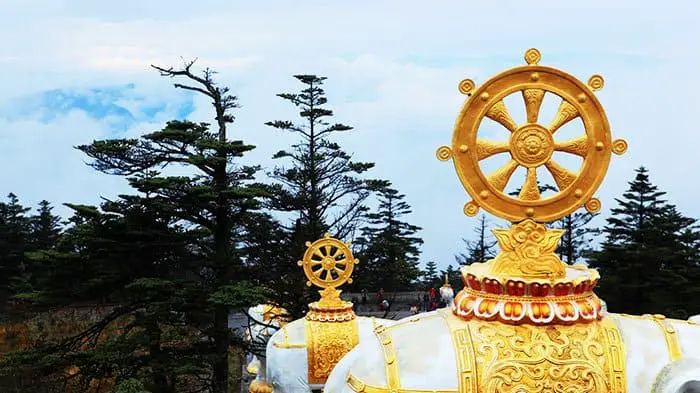
Historian Robert Beer, a scholar of Buddhist symbolism, notes that some of the earliest depictions of the Dharma Wheel resemble sun discs found on seals from the Indus Valley Civilization (~2500 BCE). These solar discs likely symbolized the life-sustaining power of the sun and the eternal cycles of time.
Later, this symbolism reappears in Hindu scriptures such as the Puranas, which poetically state:
“The chariot of the Sun God has only one wheel.”
(Vishnu Purana, ~400 CE)
This “wheel of the sun” became the prototype for the Dharma Wheel: illuminating, life-giving, and eternally turning.
⚖️ 2. Dharma as Universal Law (Vedic Origins)
The word “dharma” comes from the Sanskrit root dhri, meaning “to uphold” or “to sustain.”
In the Vedas—India’s oldest spiritual texts (c. 1500–1200 BCE)—dharma was not just a moral code. It was the cosmic law that sustains order, truth, and natural harmony
(Jamison & Brereton, 2014).
It was understood to govern:
- The rotation of the planets
- The cycles of nature
- The social and moral order of civilization
- The inner alignment of the soul with truth
Dharma is what keeps the universe from descending into chaos—and the Dharma Wheel is its symbol of balance in motion.
🚛 3. The Dharma Wheel as a Chariot of Civilization
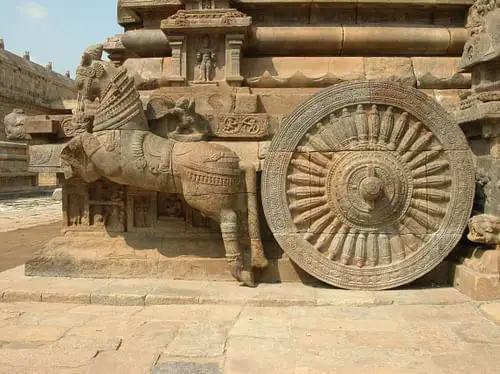
As symbolism evolved, the Dharma Wheel came to represent the wheel of an ancient chariot—used not just for war, but for movement, progress, and spiritual journey.
This chariot-wheel has three core parts:
🔘 The Hub: Inner Discipline and Centeredness
At the center of the wheel is the hub, representing moral discipline, stillness, and the core values that stabilize our lives.
- It is the anchoring center of the self, around which all action revolves.
- In some traditions, the hub is depicted as a yin-yang symbol, reflecting balance between opposites.
- In others, it features three swirling segments, symbolizing the Three Treasures of Buddhism:
Buddha (the awakened one),
Dharma (the path), and
Sangha (the community).
The hub reminds us that without an ethical core, the wheel cannot spin in harmony.
The Spokes: Paths of Right Action
Radiating outward from the hub are the spokes, which represent the various ethical principles and spiritual practicesthat support the journey of awakening.
- Most commonly, these are linked to the Noble Eightfold Path—eight spokes, eight disciplines.
- In other versions, they may represent the Four Noble Truths, the Twelve Links of Dependent Origination, or even the 31 Realms of Existence.
The spokes are what connect inner values to outer actions—turning stillness into forward motion.
The Rim: Mindfulness and Unity
Encircling the wheel is the rim, which holds everything together and gives the wheel its circular, continuous motion.
- The rim represents meditation, mindfulness, and mental concentration—the practices that unify and sustain the spiritual path.
- It also reflects the perfection and continuity of dharma itself: eternal, unbroken, and all-encompassing.
In both Buddhist and Hindu disciplines, the rim is understood as the discipline of awareness that keeps the whole system in balance.
Author and Zen Buddhism expert Barbara O’Brien eloquently describes the wheel’s essence:
“The wheel rolls forward like a chariot—toward awakening.”
What the Number of Spokes on the Dharma Wheel Really Means
Over centuries, the number of spokes on the Dharma Wheel has varied—each configuration reflecting a different layer of spiritual meaning, ethical insight, or cosmic truth.
Some traditions depict the spokes as contained within the circle—emphasizing wholeness and integration. Others show them extending outward, like blades of wisdom cutting through ignorance.
From 4 to 31 spokes, each variation encodes a specific teaching—from the Four Noble Truths to the Eightfold Path, the Twelve Links of Dependent Origination, and even the cosmological realms of rebirth.
The pattern may change,
but the message is always the same:
Truth moves in all directions—and dharma is the path that holds it together.
Let’s break down what each spoke configuration represents—and why it matters.
4 Spokes: The Four Noble Truths
The 4-spoked Dharma Wheel is less common but highly significant. It represents the Four Noble Truths, which form the foundation of Buddhism. Each spoke is a fundamental insight about suffering and liberation:
- Dukkha – Life includes suffering, discomfort, and dissatisfaction
- Samudaya – Suffering arises from craving, attachment, and desire
- Nirodha – Letting go of craving ends suffering
- Magga – The Noble Eightfold Path is the way out
These truths were the first teachings of the Buddha after enlightenment—setting the wheel of dharma in motion for the first time.
8 Spokes: The Noble Eightfold Path (Most Common)
The 8-spoked Dharma Wheel is the most recognized form in Buddhism. Each spoke represents one element of the Eightfold Path, which guides ethical behavior, mental clarity, and spiritual awakening:
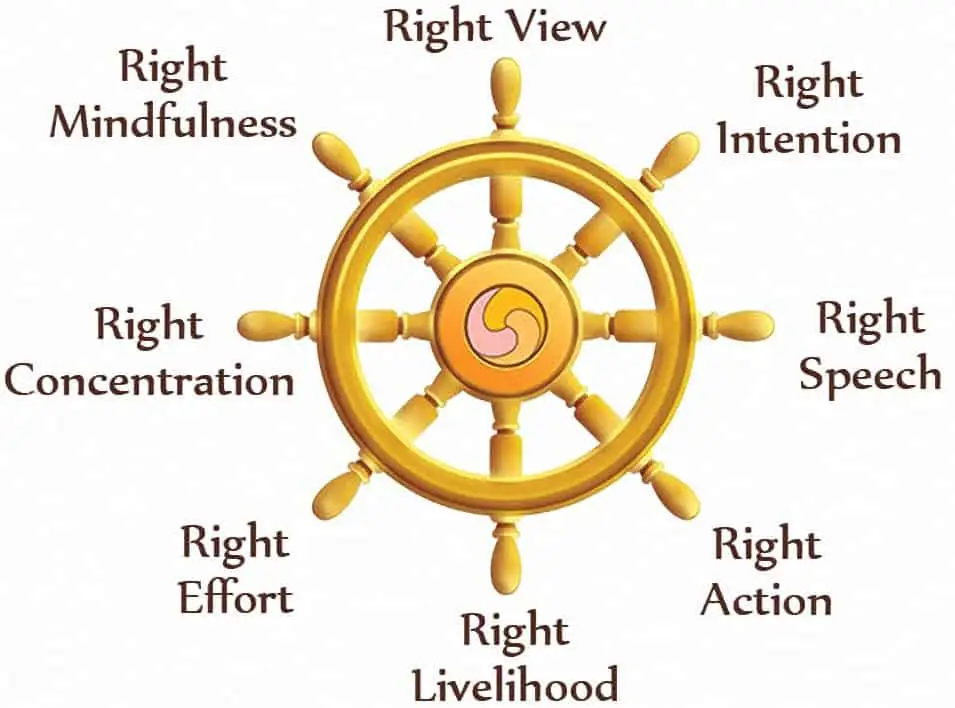
- Right View – Seeing life clearly and understanding cause and effect
- Right Intention – Choosing love, compassion, and renunciation over greed or ill will
- Right Speech – Speaking truthfully, kindly, and constructively
- Right Action – Acting morally: no killing, stealing, or misconduct
- Right Livelihood – Earning a living in ways that cause no harm
- Right Effort – Persistently cultivating positive states of mind
- Right Mindfulness – Being present and aware of body, thoughts, and emotions
- Right Concentration – Deep focus and meditation that purifies awareness
The Eightfold Path is the spiritual axle of the Dharma Wheel—carrying the practitioner steadily toward liberation.
10 Spokes: The Ten Directions of Awareness
The 10-spoked wheel symbolizes the omnipresence of the awakened mind. It reflects the idea that the truth of dharma radiates in every direction:
- Cardinal directions: North, South, East, West
- Intercardinal directions: Northeast, Northwest, Southeast, Southwest
- Vertical dimensions: Up and Down
This version reminds us that awakening is not bound by geography—it is available everywhere, to everyone. Buddhist texts often pair this concept with the “three times” (past, present, future), reinforcing dharma’s timeless and universal reach.
12 Spokes: The Twelve Links of Dependent Origination
The 12-spoke Dharma Wheel represents the Twelve Nidānas—the interconnected links that describe how suffering arises and perpetuates itself across lifetimes:
- Ignorance
- Volitional formations (karma)
- Conditioned consciousness
- Name and form (body and mind)
- Six sense bases
- Contact
- Sensation
- Craving
- Attachment
- Becoming
- Birth
- Aging, death, and decay
These links describe the cycle of samsara (rebirth). By understanding and interrupting the chain—especially at the point of craving—we can stop the wheel of suffering and start the path to freedom.
24 Spokes: The Ashoka Chakra – Balance Between Suffering and Liberation
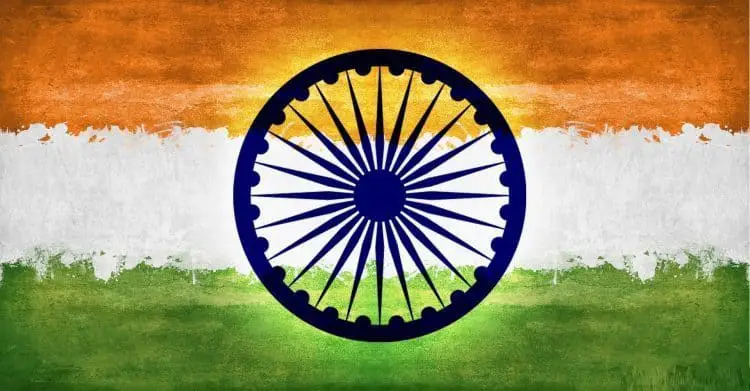
The 24-spoked Dharma Wheel, known as the Ashoka Chakra, is far more than a national symbol—it’s a profound map of transformation through dharma.
Featured at the heart of the Indian national flag, this version of the Dharma Wheel represents a balanced spiritual equation:
- 12 spokes symbolize the Twelve Links of Dependent Origination—the chain of suffering, craving, and rebirth
- 12 counter-spokes represent the Twelve Paths of Liberation—the antidotes to each cause of suffering
Together, these 24 spokes form a wheel that moves the individual—and society—beyond sorrow.
volution (India Ministry of Culture).
A 24-spoke Dharma Wheel is, quite literally, a symbol of moving beyond suffering—into harmony, balance, and peace.
Ancient Vedic Origins: 24 Rishis and the Gayatri Mantra
The sacred number 24—now central to the Ashoka Chakra’s 24 spokes—can be traced even deeper into Vedic tradition.
According to ancient texts, there were 24 Rishis, or seers, who each embodied and transmitted divine knowledge. These sages weren’t just scholars—they were the original carriers of vibration, transmitting truth not just through words, but through resonance.
Their legacy lives on through the Gayatri Mantra, one of the most revered verses in Hinduism—composed of 24 syllables.
This mantra is an invocation of pure consciousness,
a hymn to the universal source of light, order, and awakening.
The symmetry is striking:
24 syllables of cosmic invocation,
24 spokes of the Dharma Wheel in motion.
Each a symbol of alignment through vibration—within the self and the universe.
31 Spokes: 31 Realms of Existence
According to ancient Buddhist cosmology, when a Dharma Wheel has a total 31 spokes, the spokes represent the “31 realms of existence”.
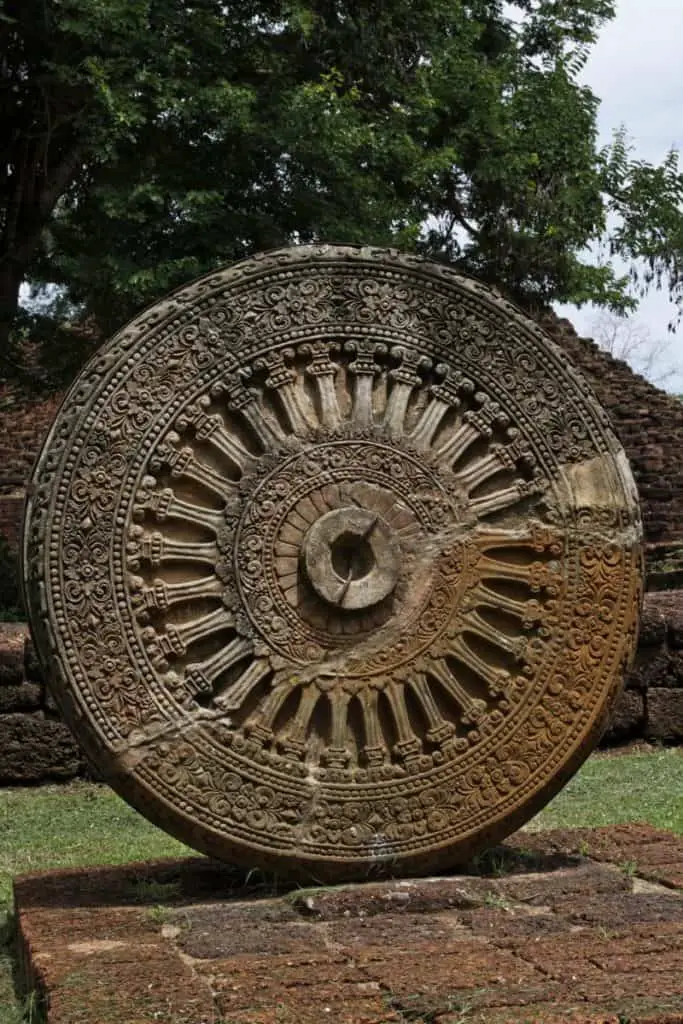
In Buddhist cosmology, a Dharma Wheel with 31 spokes symbolizes the 31 realms of existence into which a being can be reborn, depending on their karma.
These realms fall into three general categories:
- Lower realms: Realms of hell, hunger, and animal suffering
- Middle realms: Human and demi-god lives (with a mix of pleasure and pain)
- Higher realms: Blissful divine planes and formless states of meditative absorption
The 31-spoke wheel is a map of spiritual destiny—and dharma is the compass. Where you land depends on the quality of your mind, speech, and actions.
🔄 Turning the Wheel: Dharma in Motion
The Motion Of The Dharma Wheel
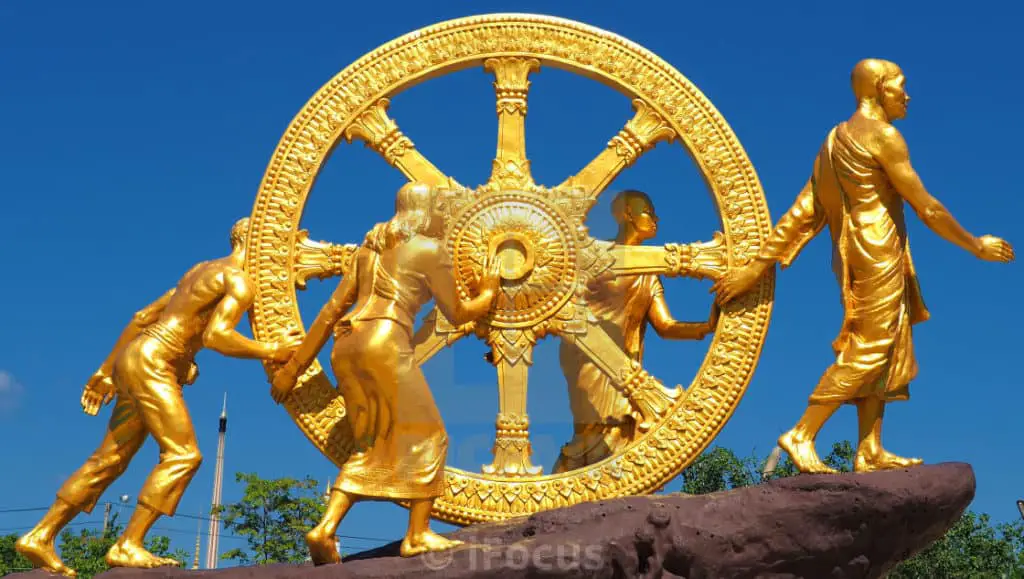
Have you ever heard the saying “set the wheel in motion” in reference to a plan or action already underway.
According to Piyadassi Maha Thera (one of the world’s most respected Buddhist monks) the original Buddha is said to have “set the wheel-of-dharma in motion” , in a metaphorical sense, when he delivered his first sermon.
When Gautama Buddha delivered his first sermon at the Deer Park in Sarnath over 2,500 years ago, he did more than just speak—he set the Dharma Wheel in motion.
This moment, known as the “Dhammacakkappavattana Sutta”, is remembered as the exact point where the wheel of awakening began to turn—signaling the start of a spiritual revolution that would transform the world.
As Piyadassi Maha Thera explains, this act wasn’t symbolic alone—it marked the beginning of a living tradition whose teachings, insights, and momentum still ripple across humanity today.
The Wheel-Turning King (Chakravartin)
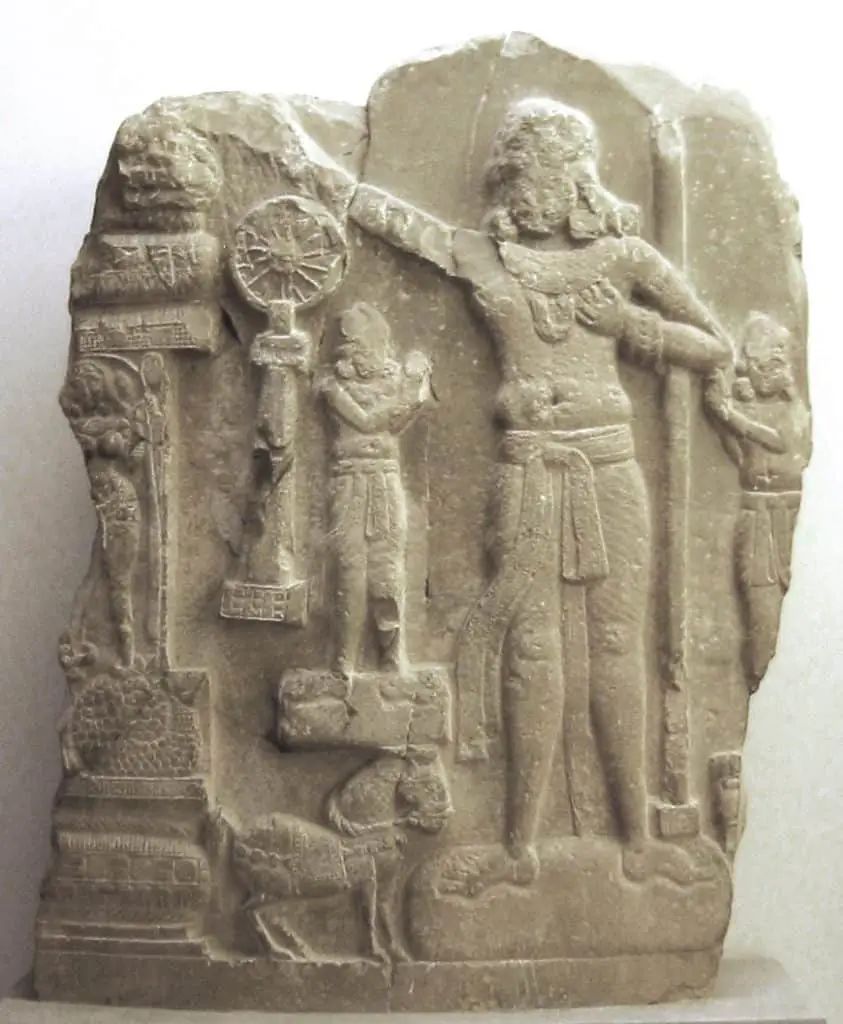
The concept of “turning the wheel” wasn’t new to ancient India. Buddha was consciously echoing the ancient archetype of the Chakravartin—the “Wheel-Turning Monarch.”
In traditional Indian cosmology, a Chakravartin was not a conqueror, but a ruler of righteousness, one who governed by truth, wisdom, and dharma rather than force.
This legendary king possessed seven sacred treasures—including the Ratana Cakka (the “precious wheel”)—a divine symbol of rightful authority and moral leadership. The Buddha, however, redefined the meaning of the wheel:
Rather than ruling empires, he aimed to rule the self.
🦌 The Deer and the Dharma
Pair Of Deer Symbolism
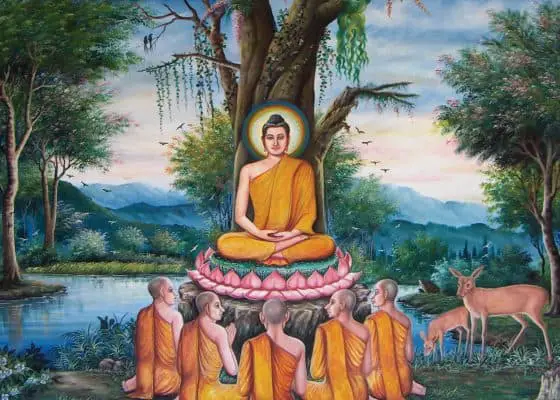
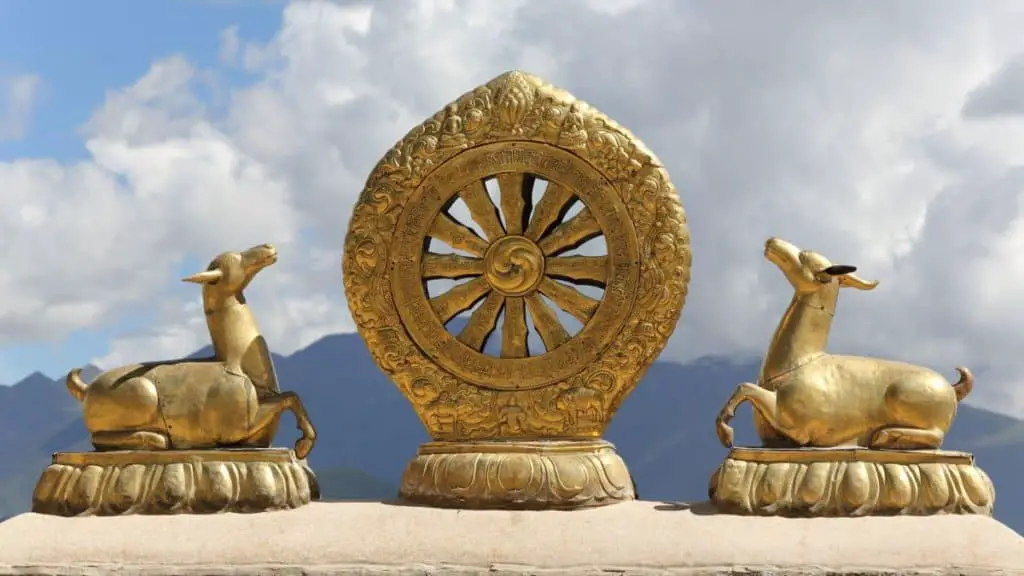
According to Buddhist tradition, when the Buddha accepted his role as teacher of the Dharma, the heavenly god Brahmais said to have offered him a thousand-spoked wheel—urging him to teach the world the path of awakening.
At that very moment, a pair of deer appeared—one male, one female—emerging from the forest to sit beside him.
These deer, now seen in countless Buddhist temple icons, symbolize:
- Gentle compassion
- Reverence for life
- Balance between the masculine and feminine aspects of the seeker
Their presence reminds us that fear dissolves in the presence of truth, and that dharma is a path of peace.
How to Turn the Dharma Wheel in Real Life
Modern life spins fast—faster than we’re built to handle.
Attention is fragmented. Outrage is rewarded. Truth feels optional.
And beneath the noise, many are asking:
How do I stay grounded? How do I live with purpose—without burning out or selling out?
The Dharma Wheel isn’t just ancient art—it’s a system for realignment.
Its design maps perfectly to how we can show up today with more clarity, calm, and conscience.
Let’s break it down.
🔘 The Hub: Stay Centered When Everything’s Spinning
The hub is stillness.
Without it, the wheel can’t turn.
In today’s world, staying centered isn’t self-care—it’s survival.
What this looks like now:
- Pause before responding—to anyone or anything.
- Block out time with no inputs. No news. No notifications.
- Get clear on your values. Then act like they matter.
🧠 When you’re off-center, everything feels urgent.
When you’re grounded, you get to choose what matters.
🕸️ The Spokes: Live Your Values, Even When It’s Hard
The spokes turn intention into action.
They’re the proof that your inner life shows up in the real world.
Why it matters now:
Your choices ripple. Online, offline, everywhere.
How to live it today:
- Post with purpose. Share less noise, more signal.
- Buy based on ethics—not ads.
- Use digital tools with integrity, not just convenience.
- Speak up in your workplace, community, or circle—especially when it’s uncomfortable.
Right action today isn’t about being perfect.
It’s about not outsourcing your conscience to convenience or culture.
The Rim: Stay Aligned in a Fragmented World
The rim holds it all together.
In Buddhist terms: mindfulness.
In modern terms: staying connected to what you’re doing, and why.
What it looks like in 2025 and beyond:
- Don’t start your day in reaction mode.
- Build habits that sync your nervous system, not fry it.
- Notice what steals your presence. Then shift it.
- Make your productivity reflect your priorities—not your panic.
The rim isn’t about hustle—it’s about harmony.
Because without alignment, even progress becomes burnout.
🧘♀️ Dharma Isn’t Theory. It’s a Daily Choice.
Every time you slow down, speak truth, or act with intention—you’re turning the wheel.
Not metaphorically.
Actually.
And the world needs more people who live like that.
✨ You don’t need a temple.
You need a clear center, aligned action, and presence that holds it all together.
That’s dharma.
That’s the wheel.
That’s the invitation.
FAQ: Dharma Wheel Meaning, Symbolism & Use
- 4 spokes = Four Noble Truths
- 8 spokes = Noble Eightfold Path
- 12 spokes = Links of Dependent Origination
- 24 spokes = Balance of suffering and liberation (Ashoka Chakra)
- 31 spokes = Realms of rebirth in Buddhist cosmology
Final Reflection: A Still Point in a Spinning World
The world moves fast.
But you don’t have to.
The Dharma Wheel has turned through centuries—empires rising, systems falling, seasons changing.
And still it turns.
Still it points to something steady beneath it all.
That steadiness lives in you.
Not in your titles.
Not in your feed.
Not in your plans.
In your center.
Every time you pause instead of react…
Choose compassion over control…
Act with intention instead of impulse…
You are living dharma.
You are becoming the wheel.
🌍 The Future Doesn’t Need More Noise.
It needs more stillness with direction.
It needs more people who remember what matters.
People like you.
So here’s the invitation:
Slow down.
Come back to the center.
Let clarity, kindness, and courage lead the way.
Not for perfection.
But for presence.
Because the world doesn’t change when we try to control it.
It changes when we show up aligned.
🌀 You are the turning.
**Thanks For Reading — Seriously**
If you made it this far, we genuinely appreciate your time. The Conscious Vibe exists to ask better questions, explore deeper ideas, and share curiosity that might spark a new idea or a new perspective.
If you found this article helpful, let us know and if this sparked something in you — share the vibe.
You may have noticed that there are no ads here. No popups. And we like it that way.
If you feel like donating to support more informative thought provoking ideas and information, we sincerely appreciate it !!
Check out our donation page to help Support Conscious Vibe
It helps cover servers, admin tools, and pretty much keeps the lights on around here.