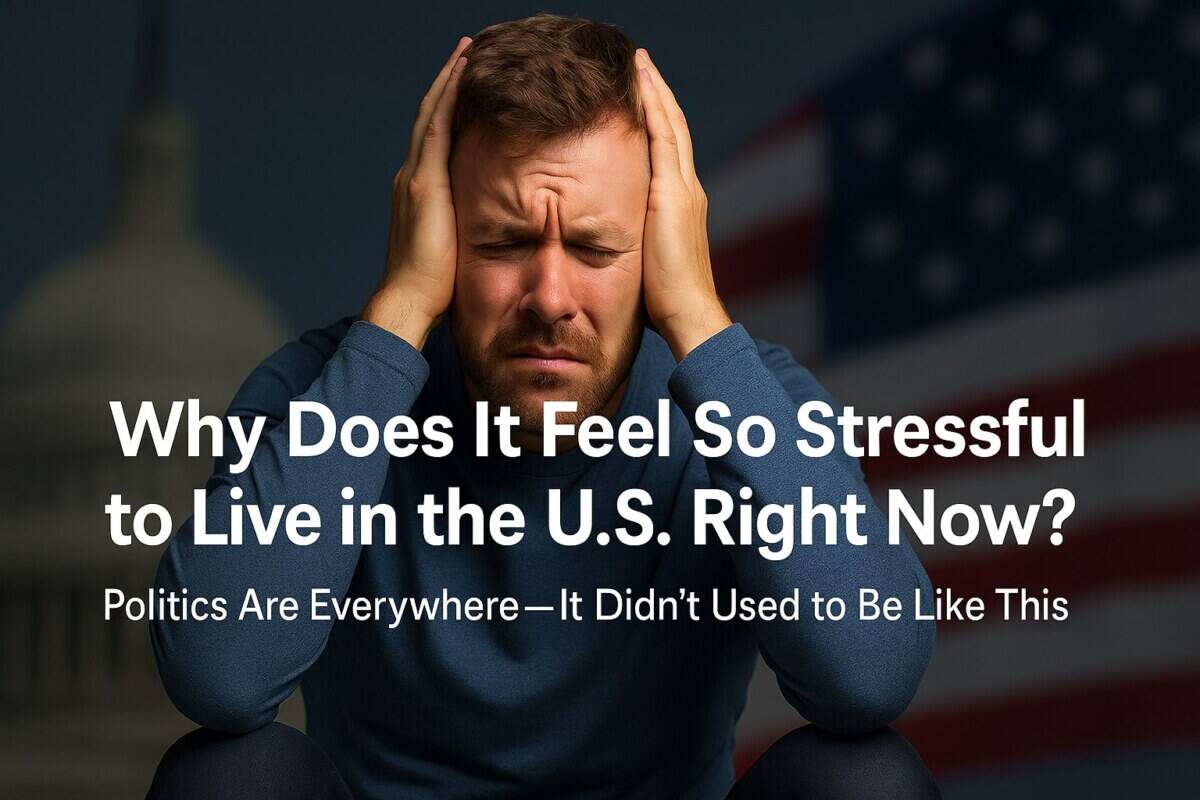
Why Does It Feel So Stressful to Live in the U.S. Right Now? Politics Are Everywhere— It Didn’t Used to Be Like This
Introduction: The Pervasiveness of Politics in Daily Life
In the 21st century, American public life has undergone a profound transformation: politics, once mostly confined to elections, civic meetings, and specialized media, now saturates nearly every aspect of daily existence.
Conversations about governance, identity, and power have migrated from the ballot box to dinner tables, workplaces, coffee shops, and personal relationships — and they never truly pause.
This phenomenon is not random. It reflects deeper, converging forces: accelerating economic inequality, the fragmentation of cultural consensus, the collapse of traditional media gatekeepers, and the rise of algorithm-driven platforms that monetize emotional engagement.
Research from Harvard’s Kennedy School (Fukuyama, 2020) describes this shift as a move from a procedural democracy — where institutions mediate conflict — to a tribal democracy, where identity groups clash continuously for validation and survival.
At a biological level, humans evolved in small, tightly bonded tribes (Dunbar’s Number theory), meaning our cognitive systems are poorly equipped to handle mass-scale, hyper-saturated political environments. Prolonged exposure to perceived threats, even abstract political ones, chronically activates our stress pathways — eroding empathy, fueling anger, and making rational deliberation exceedingly difficult (Sapolsky, 2017; Rose, 2022).
In this blog, we explore why Americans — and many citizens globally — increasingly experience political life as a source of stress, anxiety, and existential pressure. More importantly, we’ll map out tangible strategies for maintaining clarity, resilience, and agency amidst this intensifying storm.
Watch the breakdown: This 5-minute video sets the tone for everything that follows.
II. The Emotional Toll: Politics as a Major Stressor
A. Mental Health Impact
Chronic political stress triggers the brain’s threat-detection circuitry—the amygdala and hypothalamic–pituitary–adrenal (HPA) axis—much like the persistent low-intensity danger signals in post-9/11 societies. Over time, this leads to elevated cortisol levels, hippocampal atrophy, and impaired executive function YouTube. A January 2025 survey found 75% of U.S. adults reporting anxiety or depressive symptoms they directly attribute to the political climate Kinsta®.
Analogy: Imagine your brain’s stress alarm installed on a hair trigger—every flash headline or tweet pings a “threat.” Over weeks and months, that alarm never fully resets, wearing down the neural circuitry.
B. Physical Health Consequences
Persistent activation of stress pathways manifests somatically:
- Fatigue & Sleep Disturbance: Dysregulated cortisol rhythms interrupt the sleep-wake cycle, decreasing deep (slow-wave) sleep and impairing memory consolidation WordPress.com.
- Cardiovascular Risk: Epidemiological data link political turmoil (e.g., contentious election cycles) to spikes in heart attacks and strokes, akin to surge effects seen during natural disasters WordPress Development Stack Exchange.
- Immunosuppression: Chronic HPA activation suppresses lymphocyte function, increasing vulnerability to infections—a “stress-induced immune hangover.”
C. Coping Mechanisms
Conscious interventions can restore regulatory balance:
- Mindfulness & Compassion Meditation: Meta-analyses show regular practice reduces amygdala reactivity and normalizes prefrontal control over stress responses .
- News Fasting: Deliberate “media sabbaths” recalibrate threat sensitivity—akin to a digital detox resetting receptor down-regulation in overstimulated sensory systems.
- Community Rituals: Participating in shared narratives (e.g., neighborhood forums) bolsters social cohesion, buffering the isolating effects of divisive rhetoric .
III. The Rise of Populism and Political Polarization
A. Economic Inequality as Populist Fuel
Since the 1971 decoupling from the gold standard, U.S. monetary expansion has disproportionately inflated asset values, concentrating wealth among the top decile. The Gini coefficient’s upward trajectory parallels the rise of populist vote shares in both left- and right-wing movements HubSpot Blog. Frustration with a “rigged game” animates slogans from Bernie Sanders to Trump: different flavors, same underlying grievance.
B. Cultural and Social Factors
Beyond dollars and cents, status anxiety—the fear of downward mobility—drives individuals toward charismatic populists who promise to restore lost prestige. Research in social neuroscience demonstrates that perceived threats to social identity activate pain pathways similar to physical injury Reddit. This explains why cultural flashpoints (immigration, gender roles) ignite populist fervor.
C. Global Trends: A Planetary Fever
Populism today resembles a viral contagion:
- Europe: Brexit and the rise of parties like Vox in Spain reflect the same “elite vs. people” narrative WPCode.
- Latin America: From Bolsonaro in Brazil to López Obrador in Mexico, economic discontent finds expression in both right- and left-wing populism.
- Asia & Africa: Even in nominally non-Western contexts (e.g., Modi’s India, Orbán’s Hungary), the formula is identical: us vs. them, amplified by social media.
Analogy: Just as a fever indicates systemic infection, populism signals deep structural imbalances—economic, cultural, and informational—that transcend borders.
IV. The Role of Social Media and the 24/7 News Cycle
A. Information Overload and Empathy Fatigue
The relentless influx of political content via social media and continuous news cycles has led to a phenomenon known as “empathy fatigue.” This condition arises when individuals become desensitized to constant negative information, leading to emotional numbness and reduced capacity for empathy. Studies indicate that excessive exposure to distressing news can impair emotional regulation and increase anxiety levels. Synergy eTherapy+2Psychology Today+2Cleveland Clinic+2
Moreover, the compulsive consumption of negative news, often termed “doomscrolling,” has been linked to significant mental health issues. Research from Norway suggests that individuals engaging in prolonged periods of doomscrolling are substantially more likely to experience serious mental health problems, including depression and anxiety. dailytelegraph
B. Misinformation and the Amplification of Division
Social media platforms have become fertile grounds for the rapid spread of misinformation. The design of these platforms often prioritizes engagement over accuracy, leading to the proliferation of false or misleading information.This environment exacerbates societal divisions and heightens public anxiety.
The psychological underpinnings of misinformation spread include cognitive biases such as confirmation bias, where individuals favor information that aligns with their existing beliefs. This bias, combined with the emotional appeal of sensational content, facilitates the viral spread of misinformation.
C. Algorithmic Influence and the Formation of Echo Chambers
The algorithms that curate content on social media platforms often create “echo chambers,” where users are predominantly exposed to information that reinforces their existing views. This selective exposure can intensify political polarization and reduce openness to diverse perspectives. Wikipedia
Additionally, the phenomenon of algorithmic radicalization has been observed, where recommendation systems progressively direct users toward more extreme content. This process can lead to the reinforcement of radical beliefs and increased societal fragmentation. Wikipedia+1ResearchGate+1
V. The Erosion of Trust in Institutions
A. Declining Confidence in Public Institutions
Public trust in governmental and public institutions has seen a significant decline over recent decades. Factors contributing to this erosion include perceived inefficiencies, lack of transparency, and failure to address public concerns effectively. This decline in trust undermines the legitimacy of institutions and can lead to increased political instability.
For instance, a recent survey indicates that only a minority of young Americans express trust in federal institutions, reflecting a broader trend of skepticism among younger demographics. Politico
B. Perceived Inequities and Disillusionment
A growing perception that systems favor elites has contributed to widespread disillusionment. This sentiment is fueled by economic disparities, social injustices, and a sense that institutional mechanisms are unresponsive to the needs of the general populace. Such perceptions can erode social cohesion and foster cynicism toward democratic processes.
C. Impact on Civic Engagement and Democratic Processes
The erosion of trust in institutions has tangible effects on civic engagement. Individuals who perceive institutions as untrustworthy are less likely to participate in democratic processes, such as voting or community involvement. This disengagement can weaken democratic structures and hinder the implementation of policies that reflect the public’s interests.
Furthermore, financial insecurity has been linked to reduced civic participation, suggesting that economic factors also play a critical role in shaping public engagement.
VI. Comparative Perspectives: How Does the U.S. Stack Up?
A. Global Quality of Life Rankings
Globally, nations such as Luxembourg, Denmark, Finland, and the Netherlands consistently score highest in measures of quality of life, political stability, and social trust (World Happiness Report, 2024).
These countries share critical traits:
- Strong social safety nets (e.g., universal healthcare, unemployment support)
- Low inequality (measured by Gini coefficients)
- High trust in public institutions (legislature, judiciary, police)
In contrast, the United States, despite its high GDP per capita, consistently ranks lower in well-being indices — largely due to economic insecurity, political distrust, and social fragmentation.
Analogy: Think of a garden. Nordic countries maintain a stable, evenly watered ecosystem. The U.S. garden has lush areas (wealthy enclaves) but suffers widespread drought elsewhere, breeding resentment and division.
B. Political Climate
Although no society is immune to political conflict, the pervasiveness of politics in daily American life is uniquely intense (Pew Research, 2024).
Key differences:
- Two-party system: Forces binary “us vs. them” thinking (compared to multi-party consensus models in Europe).
- Commercialized media: 24/7 outrage-driven news cycles incentivize constant agitation.
- Cultural individualism: High value on personal identity often fuses political allegiance with self-concept, raising the emotional stakes.
Scientific Insight: Collective illusions—shared misperceptions about what others believe—amplify polarization. (Todd Rose, Collective Illusions, 2022).
C. Cultural Differences
Cross-national studies reveal that media ecosystems, education levels, and civic norms determine how politically saturated everyday life feels:
- In Finland, news consumption is high, but trust remains strong due to rigorous public broadcaster standards (Yle News Trust Index 2023).
- In the U.S., mistrust leads many citizens into fragmented “truth markets” via social media and partisan outlets, accelerating emotional polarization.
VII. Cultivating Conscious Awareness: Staying Informed Without Getting Overwhelmed
A. Critical Thinking
Developing epistemic vigilance—the ability to critically assess the trustworthiness of information—is vital in the disinformation age (Sperber et al., Cognition, 2010).
Key practices include:
- Source triangulation: Cross-check multiple independent sources.
- Bias spotting: Actively identify framing biases (emotive language, selective omission).
Analogy: Treat news like nutrition. Processed clickbait inflames you; slow, whole information nourishes sound judgment.
B. Mindful Consumption
A meta-analysis of digital media use shows that setting time-based limits dramatically reduces political anxiety and improves mental health (Twenge & Campbell, PNAS, 2023).
Effective strategies:
- Designate “news windows” (e.g., 20 minutes each morning).
- Replace late-night scrolling with restorative habits (reading, meditation, art).
- How to use Social Media MORE MINDFULLY
C. Media Literacy
Becoming media literate means not just recognizing fake news, but understanding agenda setting, framing, and confirmation bias traps (National Association for Media Literacy Education, 2024).
Teach yourself to ask:
- Who benefits from me believing this?
- What voices or data are missing?
D. Emotional Regulation
Neuroscientific studies show that emotional hijacking by news triggers the amygdala, short-circuiting rational thought (Goleman, Emotional Intelligence, 1995).
Cultivate practices like:
- Pause → Label → Reframe: Notice emotional surges (“I’m feeling anger”), contextualize (“This story is designed to provoke”), and recalibrate focus.
- Polyvagal exercises: Breathwork or humming can engage the vagus nerve, restoring parasympathetic calm ([Porges, Polyvagal Theory, 2011]).
Big Picture: In an economy of outrage, regulating your emotional attention is an act of conscious rebellion.
VIII. Coping Mechanisms and Paths Forward
A. Individual Strategies
- Mindfulness meditation: Longitudinal studies show that regular mindfulness practice shrinks amygdala volume and strengthens prefrontal inhibitory control (Hölzel et al., Psychiatry Research, 2011).
- Exercise: Physical movement downregulates stress hormones like cortisol and boosts endorphins—an immediate antidote to political stress cycles.
B. Community Engagement
- Social capital theory (Putnam, Bowling Alone, 2000) shows that strong local networks (neighbors, clubs, co-ops) buffer against national discontent.
- Engage in hyperlocal activism (school boards, local farms, libraries) where efforts yield visible, tangible outcomes—this restores agency lost in national-scale crises.
Analogy: National politics feels like steering an ocean liner with a teacup. Local community work feels like steering a bike—small but responsive.
C. Policy Recommendations
Address root causes, not just symptoms:
- Economic Rebalancing: Support policies that strengthen the middle class (e.g., employee ownership models, living wage standards) to reduce inequality-driven populism ([Stiglitz, People, Power, and Profits, 2019]).
- Transparency Reforms: Push for algorithmic transparency in media platforms to reduce manipulation and restore credible information ecosystems.
In Summary:
Navigating today’s hyper-politicized, emotionally-charged landscape demands not more outrage, but more consciousness. By mastering emotional regulation, critical media habits, community building, and policy literacy, individuals can reclaim personal agency—and contribute to a healthier civic ecosystem for all.
IX. Conclusion: Navigating a Politically Charged Environment
The current political environment in the United States is best understood as an ecosystem out of balance — oversaturated, overheated, and locked in feedback loops of conflict and emotional reactivity. Structural forces such as rising economic inequality, algorithmic information warfare, institutional distrust, and unresolved cultural traumas have created a perfect storm where politics feels omnipresent, volatile, and deeply personal.
Yet within this turbulence lies an opportunity: to reclaim consciousness, agency, and balance. Neuroscientific research shows that the human brain is remarkably plastic. With practices like mindfulness, media literacy, emotional regulation, and deliberate community engagement, individuals can rewire their reactions, reduce chronic stress, and become stabilizing forces in a destabilized system (Siegel, 2012; Porges, 2011).
Social science offers similar hope: rebuilding local trust, focusing on tangible civic action, and advocating for systemic reforms can heal not only individual lives but entire civic ecosystems (Putnam, 2000; Stiglitz, 2019).
In the end, escaping the trap of modern political overwhelm is not about retreating into apathy, nor about doubling down into tribal outrage. It’s about cultivating conscious engagement — staying informed without being inflamed, grounded without being detached, compassionate without being naïve.
In a world engineered to monetize attention and outrage, choosing awareness, calm, and wise action is not just a personal survival skill — it is an act of cultural and civilizational leadership.
**Thanks For Reading — Seriously**
If you made it this far, we genuinely appreciate your time. The Conscious Vibe exists to ask better questions, explore deeper ideas, and share curiosity that might spark a new idea or a new perspective.
If you found this article helpful, let us know and if this sparked something in you — share the vibe.
You may have noticed that there are no ads here. No popups. And we like it that way.
If you feel like donating to support more informative thought provoking ideas and information, we sincerely appreciate it !!
Check out our donation page to help Support Conscious Vibe
It helps cover servers, admin tools, and pretty much keeps the lights on around here.