How to Steal an Election – Gerrymandering Explained (Without the Politics)
Imagine winning an election without convincing more people to vote for you.
No better platform, no deeper vision—just a map and a pen. With one subtle trick, you can tilt the playing field so far in your favor that you never lose again.
Welcome to gerrymandering—a legal method of shaping power that may look like democracy, but quietly erodes its foundations.
This article isn’t about left vs. right. It’s about understanding a system of manipulation that affects all of us, regardless of politics. Because whether you’re conservative, progressive, independent, or apolitical—fair is fair. And once you understand how gerrymandering works, you’ll never look at an election map the same way again.
🔍 What Is Gerrymandering?
Gerrymandering is the practice of redrawing voting district boundaries to give one political group an advantage over another.
But here’s the key: the manipulation isn’t about changing who votes—it’s about changing how votes are counted by altering the boundaries that define who votes together.
In essence, it allows politicians to pick their voters instead of voters picking their politicians.
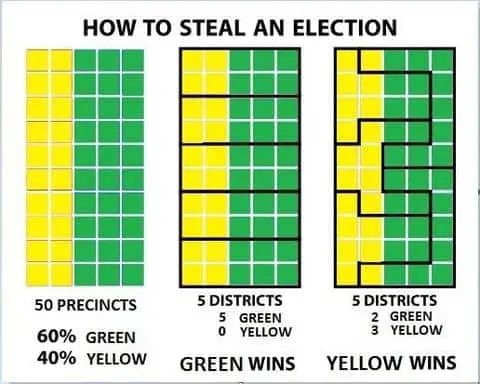
So depending on the size of a district, you can see how votes can get manipulated against the majority just by ‘re-drawing’ or “gerrymandering” the district lines.
Often with gerrymandering, districts get divided (or chopped up) in ways that make very little sense geographically.
When this general principle gets applied over multiple districts in multiple states, it can have a huge impact on both state-wide and national elections.
🧠 How Gerrymandering Works: The Two Core Tactics That Quietly Tilt Elections
To understand how gerrymandering manipulates election outcomes, you need to see how district lines—not votes—become the lever of control.
Here are the two most powerful techniques used by political strategists: Packing and Cracking. These aren’t just tricks—they’re data-driven, strategic methods of shifting power without increasing support.
📦 1. Packing – Concentrate and Neutralize
Packing is the tactic of cramming as many voters from the opposing party or opposing demographic into as few districts as possible.
The goal? Win big in a few places, but lose everywhere else.
Why it works:
- In a winner-take-all voting system (like in the U.S.), it doesn’t matter if you win a district by 51% or 90%—you still get just one seat.
- So if your opponents are going to win somewhere anyway, you want them to waste as many votes there as possible.
🔬 Visual Example:
Imagine a city with 100,000 voters, where:
- 60,000 vote for Party A (the dominant party)
- 40,000 vote for Party B (the opposition)
If you fairly divided them into 5 districts, Party A would win about 3 seats and Party B would win 2—roughly reflecting the actual voter base.
But if Party A redraws the map using packing, they might place 35,000 Party B voters into one single district, and scatter the other 5,000 across the remaining four.
The result:
- Party B wins 1 seat with 90% of the vote (wasted votes)
- Party A wins the other 4 seats narrowly (e.g., 55%–45%)
Same voters. Same number of districts. Completely different outcome.
💡 Insight:
Packing is like saying: “You can yell as loud as you want, but only in this one soundproof room.”

🪓 2. Cracking – Dilute and Divide
Cracking is the opposite. Instead of concentrating opposition voters, you spread them out across multiple districts, making sure they’re always outnumbered.
The goal? Prevent your opponents from reaching a majority anywhere.
Why it works:
- Even if opposition voters make up a large minority across a region, by splitting them up, they become electorally irrelevant in every district.
- This divides communities that might otherwise vote together based on shared values, interests, or identity.
🔬 Visual Example:
Imagine a state with 500,000 voters:
- 250,000 for Party A
- 250,000 for Party B
You’d expect an even 50/50 split in representation. But with cracking, Party A redraws the 5 districts so that Party B voters make up just 40% in each one.
That way, Party A wins all 5 districts, even though they only have 50% of the total vote.
💡 Insight:
Cracking is like taking all the strongest voices from a protest and scattering them across five different rooms, so no single room is loud enough to be heard.
🧠 When Packing and Cracking Work Together
Here’s the real trick: packing and cracking are rarely used in isolation. Political strategists often use both at the same time, targeting specific demographics and geographies with precision.
- Pack high-density opposition voters into a few urban districts
- Crack the rest into sprawling suburban or rural districts
The result?
- A few districts with massive opposition wins (often urban or minority-heavy)
- A larger number of modest wins for the party in control (often suburban and rural)
This combination can flip entire state legislatures, congressional delegations, and national policies—all without changing voter preferences.
🧬 The Science of Manipulation: How It’s Done
Gerrymandering is all about gaining or maintaining political control.
Modern gerrymandering is surgical.
Using voter rolls, census data, ethnicity maps, and digital modeling, strategists can predict voting outcomes block-by-block. Geographic Information Systems (GIS) let them simulate millions of possible district maps to find the most favorable configuration.
It’s not guesswork. It’s data science.
And the result? Districts that often make no geographic sense—but serve a very specific mathematical purpose: to entrench power.
📜 Is It Legal?
Yes—and no. Here’s where it gets tricky:
- Racial gerrymandering has been ruled unconstitutional under the Equal Protection Clause.
- But partisan gerrymandering—where districts are drawn to favor a political party—has been ruled a political question that federal courts won’t regulate (Rucho v. Common Cause, 2019).
This means in many states, the people who benefit from gerrymandering are the ones legally allowed to do it.
Most districts are drawn by state legislatures—the same politicians who run in those districts. In only a handful of states do independent commissions draw the lines.
🧭 Why It Matters to You
Even if you vote, gerrymandering can dull your voice.
It determines:
- Which party controls state and federal legislatures
- What laws get passed (or blocked)
- How much your community is heard
It can affect everything from education and healthcare funding to climate policy, gun laws, and civil rights—just by controlling the map.
The consequences of unfair maps often last an entire decade, until the next census.
🧠 Who Draws the Lines?
In most states, the state legislature draws the congressional and legislative maps. That means your local representatives may be the ones deciding how their own districts are shaped.
And there’s a growing trend: national political groups and corporate donors are spending big on local state races, because if you control the map, you control the rules.
A few states (like California and Arizona) have implemented independent commissions to combat this. But they’re still the exception.
The state legislature is made up of over 100 voting members of state level politicians.
These state level politicians vote on the district lines.
Unfortunately, large corporations with “National Political Interests” are spending a lot of money on “local” state elections in order to get local politicians elected who , once elected, will vote to change the district borders.
These massive corporate campaign contributions that lead to “gerrymandered” districts are essentially a legal loophole for corruption.
📚 The Origin of Gerrymandering
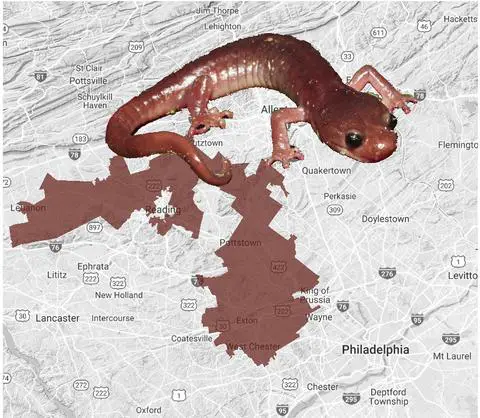
The term “gerrymandering” dates back to 1812, when Massachusetts Governor Elbridge Gerry approved a redistricting plan that favored his political allies.
One district was so oddly shaped that it looked like a salamander. A local newspaper called it “Gerry’s salamander,” and the name stuck.
What started as a local scandal became a national strategy. Over 200 years later, the word—and the practice—are more relevant than ever.
Major Gerrymandering Examples in the United States
North Carolina
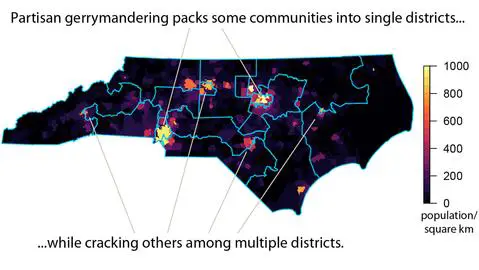
In 1993, North Carolina proposed redistricting to create a majority-black district for having a black representative winning a seat in the congress.
However, the second district was very irregular, leading to a lawsuit.
North Carolina submitted a second proposal to create two black-majority districts but it was still rejected by the U.S. Attorney General.
This was because the district shape was still very unusual and that while it is racially neutral on its face, the resulting shape is suggestive of its intention to divide the state based on race.
Texas
In 1996, Texas used sophisticated software and data to reapportion districts and have one district for the Hispanic and African-American.
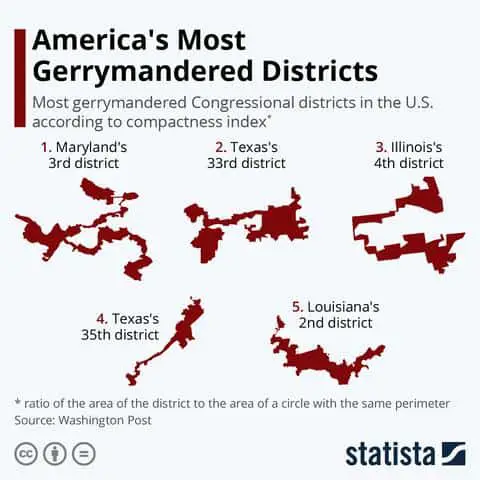
The result could have given them three extra seats in the congress.
However, it was again turned down by the Supreme Court because the division was based on race.
Alabama
In 2018, Alabama proposed for reapportionment allowing another black-majority district.
According to the state, only one of the seven districts has black-majority voters.
However, the court rejected the proposal as it was without sufficient justification for separating its citizens into different voting districts based on race.
There are also examples of partisan gerrymandering. Partisan gerrymandering mainly aims to weaken another political party or to favor another.
🌍 How Do Other Countries Prevent Gerrymandering?
While the United States struggles with district manipulation, many other democracies have developed electoral systems that are far more resistant to gerrymandering—by design.
Here are the key differences:
🇩🇪 Germany – Proportional Representation (Mixed-Member System)
Germany uses a mixed-member proportional (MMP) system. Voters cast two votes: one for a local representative (like in the U.S.), and one for a party. Half of the Bundestag seats are filled by district winners, but the other half are allocated to match the national party vote share.
- 📊 Impact: This ensures that no party wins more seats than they earn in total votes, preventing one-sided dominance through redistricting alone.
- 🔐 Safeguard: Even if districts are manipulated locally, the overall seat distribution still reflects voter intention.
🇳🇿 New Zealand – Independent Commission + Proportionality
New Zealand also uses MMP and assigns electoral boundaries via an independent, nonpartisan commissionestablished by law.
- 🗺️ Commission Structure: The Electoral Commission must consider factors like communities of interest, population equality, and existing boundaries—not political advantage.
- ✅ Transparency: All meetings are public, and maps are released in draft form before finalization.
🇨🇦 Canada – Independent Boundary Commissions
Canada uses single-member districts like the U.S., but with a major difference: electoral maps are drawn by independent, nonpartisan commissions in each province.
- 📏 Criteria: Commissions use strict rules based on geography, communities of interest, and population parity—not political affiliation.
- 💬 Public Involvement: There are public hearings before final boundaries are adopted.
- 🧩 Outcome: While no system is perfect, Canada sees far fewer cases of overt gerrymandering than the U.S.
🧠 Insight:
The U.S. model—winner-take-all in single-member districts drawn by politicians—is uniquely vulnerable to abuse. Countries that use proportional systems or independent commissions tend to better reflect the true will of the electorate and maintain greater public trust in elections.
✅ What Can the U.S. Do to Fix It?
Reforming gerrymandering is not about political advantage—it’s about structural integrity. If democracy is meant to reflect the will of the people, here’s how we can realign the system with that goal:
1. Establish Independent Redistricting Commissions Nationwide
Only a handful of states (e.g., California, Arizona, Michigan) currently use truly independent commissions to draw legislative maps. Expanding this model could:
- Eliminate conflicts of interest
- Increase public trust
- Reduce partisan manipulation
📊 Studies show independent commissions create more competitive, representative districts and reduce polarization.
2. Enforce Algorithmic Transparency
Redistricting now uses advanced software and data models. To prevent abuse:
- Make all map-drawing algorithms open-source
- Require disclosure of input data and parameters
- Allow independent auditing of district maps
3. Guarantee Public Oversight
Ensure that:
- Draft maps are released publicly
- Citizens have opportunities to give feedback
- All redistricting meetings are public and recorded
📣 Democracy works best when voters can see how the rules are being written.
4. Adopt Federal Standards for Fairness
Congress could pass legislation mandating:
- Compactness, contiguity, and community representation
- Limits on partisan bias metrics like the efficiency gap or partisan symmetry
- Redistricting reviews every 10 years following the census, under federal oversight
Even if states draw their own maps, minimum fairness criteria would set a national baseline.
🧠 Final Thought: The Lines Are the Power
We tend to focus on who wins an election—but far less on how the battlefield was drawn before a single vote was cast.
That’s the quiet genius—and danger—of gerrymandering.
It doesn’t require suppressing votes. It doesn’t break laws. It simply bends the rules of the game until one side can’t lose.
And it often goes unnoticed.
But if you’re reading this, you now know: the structure of democracy matters just as much as the outcomes. Gerrymandering is not about parties. It’s about power, access, and control.
If we want a system that reflects the people’s will—not manipulates it—we must start by drawing fair maps, with transparent tools, under public oversight.
Because when the lines are drawn in secret, so is the future.
**Thanks For Reading — Seriously**
If you made it this far, we genuinely appreciate your time. The Conscious Vibe exists to ask better questions, explore deeper ideas, and share curiosity that might spark a new idea or a new perspective.
If you found this article helpful, let us know and if this sparked something in you — share the vibe.
You may have noticed that there are no ads here. No popups. And we like it that way.
If you feel like donating to support more informative thought provoking ideas and information, we sincerely appreciate it !!
Check out our donation page to help Support Conscious Vibe
It helps cover servers, admin tools, and pretty much keeps the lights on around here.