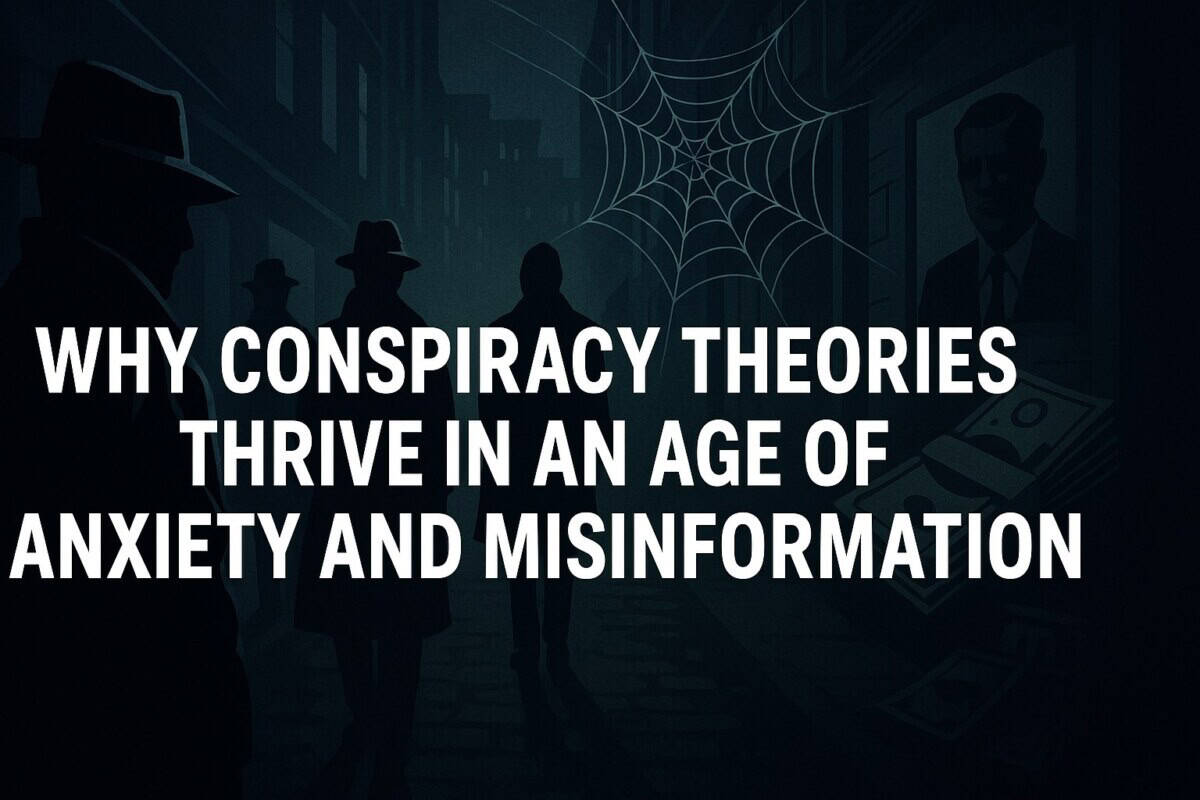
Why Conspiracy Theories Thrive in an Age of Anxiety and Misinformation
The Age of Uncertainty
We live in a time where facts feel fluid, institutions feel fractured, and the very notion of objective truth seems negotiable. This cultural fog has many sources: the explosive rise of AI, relentless media manipulation, the lingering trauma of a global pandemic, and a world order teetering on geopolitical instability.
In this environment, anxiety thrives—and so do conspiracy theories.
But this isn’t just about fringe ideas or “crazy people.” Conspiratorial thinking emerges from real psychological and spiritual needs: the need for meaning, control, identity, and belonging in a world that feels overwhelming.
In this article, we’ll explore why conspiracy theories flourish today—through the lenses of neuroscience, psychology, social dynamics, information warfare, and metaphysics—and how we can stay grounded in truth, wisdom, and conscious inquiry.
Watch the breakdown: This 5-minute video sets the tone for everything that follows.
The Brain Craves Certainty, Meaning & Control
Pattern Recognition: A Survival Mechanism with a Dark Side
The human brain is evolutionarily hardwired to recognize patterns. This instinct was once crucial for survival—early humans who could detect subtle environmental cues were more likely to find food, avoid danger, and anticipate change. Spotting animal tracks, reading weather shifts, or recognizing social dynamics meant the difference between life and death.
But this same strength becomes a vulnerability in the modern world.
In the absence of saber-toothed tigers and foraging, the brain still seeks patterns—often in the abstract, symbolic, or digital. This leads to apophenia: the tendency to perceive meaningful connections in unrelated things. In the age of hyper-information and global crisis, our minds connect dots that were never meant to be connected—linking unrelated headlines, images, and coincidences into narratives that feel true. This is a core psychological foundation of many conspiracy theories.
Why the Unknown Feels Threatening
Uncertainty isn’t just uncomfortable—it’s neurologically threatening. The human brain interprets ambiguity as a potential danger, triggering a cascade of stress responses. When life feels unpredictable—whether due to financial instability, social breakdown, or cultural shifts—the brain enters a state of hyper-vigilance.
Neurochemicals like noradrenaline (which heightens alertness), acetylcholine (which enhances learning in uncertain environments), and dopamine (which reinforces actions that feel rewarding or resolving) all surge during periods of ambiguity. This neurochemical cocktail primes us to seek resolution at any cost—even if that resolution is rooted in a false or oversimplified belief.
Dopamine, in particular, plays a critical role in belief formation. When we discover what feels like a “hidden truth” that explains our confusion, the brain rewards us with a dopamine hit. This feedback loop strengthens the belief over time, regardless of its accuracy. What begins as a hunch becomes conviction through repetition, not verification.
System 1 vs. System 2: The Cognitive Shortcut Trap
As Nobel laureate Daniel Kahneman describes in Thinking, Fast and Slow, our cognition operates through two distinct systems:
- System 1 is fast, automatic, emotional, and intuitive. It’s the reflexive gut instinct that helped our ancestors survive immediate threats.
- System 2 is slow, effortful, logical, and analytical. It’s the system we use for math, fact-checking, and critical thinking.
Under pressure—especially when anxious, overwhelmed, or emotionally charged—we default to System 1. And conspiracy theories are tailor-made for System 1: they offer quick answers, emotional validation, and simple moral binaries. They “feel” right, which makes them neurologically sticky.
Once a conspiracy belief takes hold, neuroplasticity reinforces it. The brain literally reshapes itself to accommodate the narrative, strengthening the neural circuits that support the belief and pruning away those that challenge it. Over time, this restructuring turns speculation into perception. What starts as a theory becomes reality—not because it’s true, but because the brain has committed to it on a structural level.g the brain to favor that narrative. Over time, belief becomes perception, and perception becomes reality.
Information Overload & the Collapse of Shared Reality
From Gatekeepers to Algorithms
In the past, information passed through journalists and editors. Today, it’s filtered by algorithms optimized not for truth, but for engagement. This shift has created:
- Echo Chambers: We only hear views that reinforce our own
- Filter Bubbles: We don’t know what we don’t know
- Epistemic Fragmentation: There’s no longer a shared reality
The Illusion of Research
People often Google what they already believe. AI and search algorithms reflect those beliefs back, reinforcing biases and feeding the illusion of independent discovery. This fosters confidence without clarity—and turns misinformation into conviction.
Cognitive Collapse
The volume f data we consume daily can overwhelm working memory and emotional regulation. In this state of overload, the mind seeks simplicity—often in the form of narratives that offer coherence, order, and scapegoats. Conspiracy theories provide exactly that.
Trauma, Identity & the Emotional Roots of Belief
Pain Looks for Patterns
People with unresolved trauma—especially from childhood—often struggle with uncertainty. Conspiracy theories offer explanatory frameworks that feel emotionally satisfying. They make pain seem purposeful and suffering more tolerable.
The Ego Wants to Be Special
Believing you’re “awake” while others are “asleep” offers ego gratification. It creates an identity around knowing “the truth”—a sense of being the hero in a world of sheep. This narrative becomes self-reinforcing, especially when community and belonging are built around it.
Community, Alienation, and Victimhood
Online conspiracy communities offer connection to the alienated. Shared beliefs, especially ones rooted in persecution or “us vs. them” thinking, solidify in-group identity. For the lonely, this becomes a powerful emotional tether—even if the belief system is toxic.
Conspirituality: When Consciousness Gets Co-Opted
When “Awakening” Becomes Weaponized
Movements like QAnon have infiltrated New Age and spiritual spaces. Why? Because both systems emphasize:
- Secret knowledge
- Distrust of mainstream systems
- A calling to “awaken” others
This overlap makes spiritual seekers particularly vulnerable to conspiratorial messaging—especially when it’s wrapped in beautiful visuals and affirmations of “higher truth.”
Dopamine-Fueled Rabbit Holes
Every shocking “truth” discovered online triggers a hit of dopamine. The more surprising or fear-inducing the content, the more rewarding it feels—fueling Rabbit Hole Syndrome. This cycle can override critical thinking, even in otherwise wise individuals.
Pastel Conspiracies & Spiritual Manipulation
Wellness influencers often package radical ideologies in attractive, heart-centered language—sometimes called pastel QAnon. These “truths” may look like light and love on the outside, but they erode relationships, destabilize mental health, and hijack real awakening.
The Science of Misinformation
Why Fake News Feels Real
- Illusory Truth Effect: Repetition makes lies feel true
- Backfire Effect: Debunking can reinforce false beliefs
- Outrage Algorithms: Emotional content = more engagement
These aren’t failures of intelligence. They’re exploits of human psychology.
Narrative Warfare
State actors and corporations now deploy weaponized narratives—targeted stories meant to polarize, distract, and destabilize. Combined with AI-generated content, the line between truth and fiction grows blurrier by the day.
These campaigns aren’t always overt. They often hijack moral language, spiritual concepts, or viral memes to manipulate emotion and reshape perception.
Metaphysics of Belief: How Thought Shapes Reality
The Collective Shadow
Carl Jung believed conspiracy theories could be projections of the collective unconscious. Themes like secret elites, good vs. evil, and the hero’s journey aren’t new—they’re archetypal stories resurfacing during times of crisis.
These myths may express:
- Our disowned shadow
- Our fear of chaos
- Our longing for order and justice
Belief as a Creative Force
What we believe literally shapes how we see the world. Through neuroplasticity, thoughts create pathways. Through confirmation bias, they filter our perception. Spiritually speaking, beliefs are spells—conscious or unconscious—cast onto reality.
When our beliefs are rooted in fear and separation, we see a world full of enemies. When they’re rooted in clarity and compassion, we see a world worth healing.
How to Stay Grounded in a World of Confusion
Practice Discernment, Not Cynicism
Cynicism closes the heart. Discernment opens the mind. It means questioning sources, asking deeper questions, and staying open to complexity—even when it’s uncomfortable.
📱 Build Digital Hygiene
- Limit screen time
- Vet your sources (CRAAP Test: Currency, Relevance, Authority, Accuracy, Purpose)
- Detox your mind with nature, breathwork, or silence
Return to Embodied Truth
Your body is your compass. When your mind spirals:
- Breathe
- Touch the Earth
- Feel your senses
- Move gently
Stillness is medicine in a world addicted to mental noise.
🤝 Reconnect with People & Purpose
Isolation fuels distortion. Community grounds us. Real human connection—through causes, friendships, and shared experience—restores perspective.
6 Signs You’re Engaging with a Conspiracy Theory
- A Hidden Plot: A secret elite controls everything
- A Villainous Group: Blame is projected onto “them”
- Distorted Evidence: Misleading images, cherry-picked facts
- No Coincidences: Every event must have a sinister cause
- Good vs. Evil Framing: Simplistic moral binaries
- Scapegoating: Blaming individuals or entire groups without evidence
If it feels emotionally satisfying but lacks peer-reviewed support—pause before you share.
Final Reflection: Conscious Inquiry Over Conspiratorial Thinking
True awakening doesn’t mean rejecting all narratives. It means learning to discern which narratives serve truth, healing, and human dignity.
To be awake isn’t to be outraged, paranoid, or divisive.
It’s to be:
- Curious, not closed
- Humble, not self-righteous
- Grounded, not scattered
- Compassionate, not combative
In a world saturated with fear, outrage, and noise, conscious inquiry is a revolutionary act.
🪩 Article by Kiel Jacob | The Conscious Vibe
At the intersection of science, spirit, and society—we explore truth, elevate consciousness, and stay grounded in what matters most.
**Thanks For Reading — Seriously**
If you made it this far, we genuinely appreciate your time. The Conscious Vibe exists to ask better questions, explore deeper ideas, and share curiosity that might spark a new idea or a new perspective.
If you found this article helpful, let us know and if this sparked something in you — share the vibe.
You may have noticed that there are no ads here. No popups. And we like it that way.
If you feel like donating to support more informative thought provoking ideas and information, we sincerely appreciate it !!
Check out our donation page to help Support Conscious Vibe
It helps cover servers, admin tools, and pretty much keeps the lights on around here.