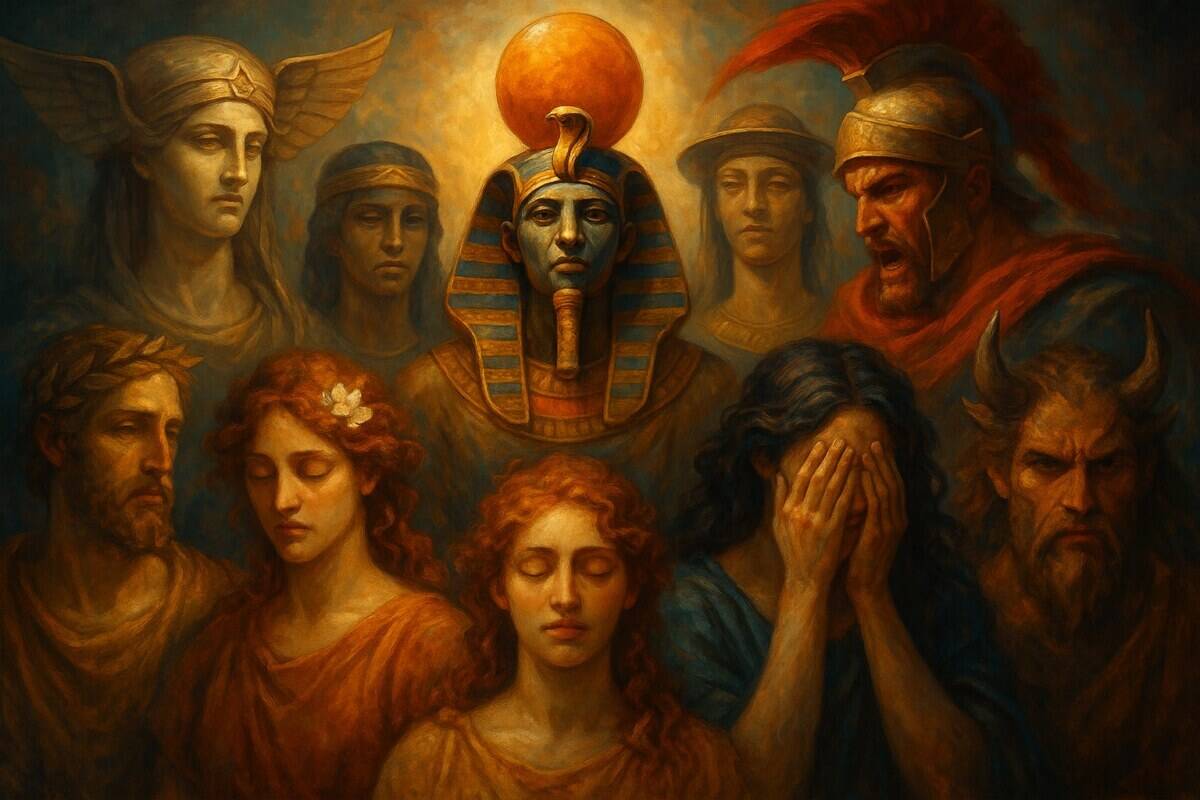
Emotional Tuning of Society: Ancient Psychological Technique Used Today
What If Emotional Architecture Was the Real Driver of Civilizations?
What if the invisible hand that moves markets, topples regimes, and rewires history isn’t purely economic or political — but emotional?
Across 5,000 years of empire cycles — from Babylon to Britain to Silicon Valley — the rise and fall of civilizations has followed a familiar arc: not just expansion and overreach, but emotional detuning.
Confidence becomes arrogance.
Trust fragments into tribalism.
Meaning is replaced by spectacle.
The story stops holding… and so does the system.
In ancient Egypt, this was framed through Ma’at — sacred order. In today’s macro models, it’s the breakdown of narrative coherence, institutional legitimacy, and incentive alignment.
Behind every monetary regime, trade bloc, or reserve currency lies a deeper layer:
The collective emotional infrastructure that determines how humans assign value, trust, and risk.
In this post, we unpack a hidden system — one that ancient rulers understood, modern strategists often overlook, and future civilizations must master:
- How ancient gods functioned as emotional archetypes embedded in governance
- Why rituals, monuments, and myths were emotional alignment mechanisms — not superstition
- How today’s political and economic systems mirror ancient playbooks in modern packaging
- What happens when narrative coherence breaks — and how emotional misalignment leads to systemic fragility
- And how reclaiming emotional sovereignty is a macro necessity — not a mystical afterthought
Because in any age — ancient or modern — the greatest lever of control has never been taxation, legislation, or trade.
It’s emotional narrative control.
The power to define what people feel, believe, and align around.
The question now is:
Are we tuning our systems toward harmony… or toward collapse?
Let’s explore the forgotten emotional infrastructure behind economic cycles, political control, and cultural resilience.
Emotion Is the Blueprint — Not the Byproduct
Civilizations don’t collapse when their armies fail.
They collapse when their emotional field fractures.
From the Roman Empire to the Soviet Union, it’s never just war, economics, or politics that cause decline.
It’s when people stop feeling in rhythm with one another — when collective coherence dissolves.
Emotion is not just a fleeting mood.
It is a field-level force — like gravity. It shapes what orbits around it: behavior, policy, identity, and belief.
In economic systems, it manifests as confidence or panic.
In markets, it shows up as sentiment.
In leadership, it emerges as charisma or collapse.
Modern neuroscience confirms what ancient architects of culture seemed to know intuitively:
- Emotions are predictive, not reactive. (Barrett, How Emotions Are Made)
- They influence choices before thought kicks in.
- They’re socially contagious — one person’s grief can become a nation’s story.
“The emotional climate of a civilization is as real — and as consequential — as its physical climate.”
— Dr. Lisa Feldman Barrett, neuroscientist
Ancient societies didn’t repress these forces.
They ritualized them.
They built temples, myths, and calendars around them — not to control emotion, but to tune it intentionally.
Today, we try to manage emotion with pharmaceuticals, productivity apps, or political memes.
But back then?
Emotion was considered a cosmic energy — sacred, collective, and central to reality.
Gods Were Emotional Archetypes — Not Characters
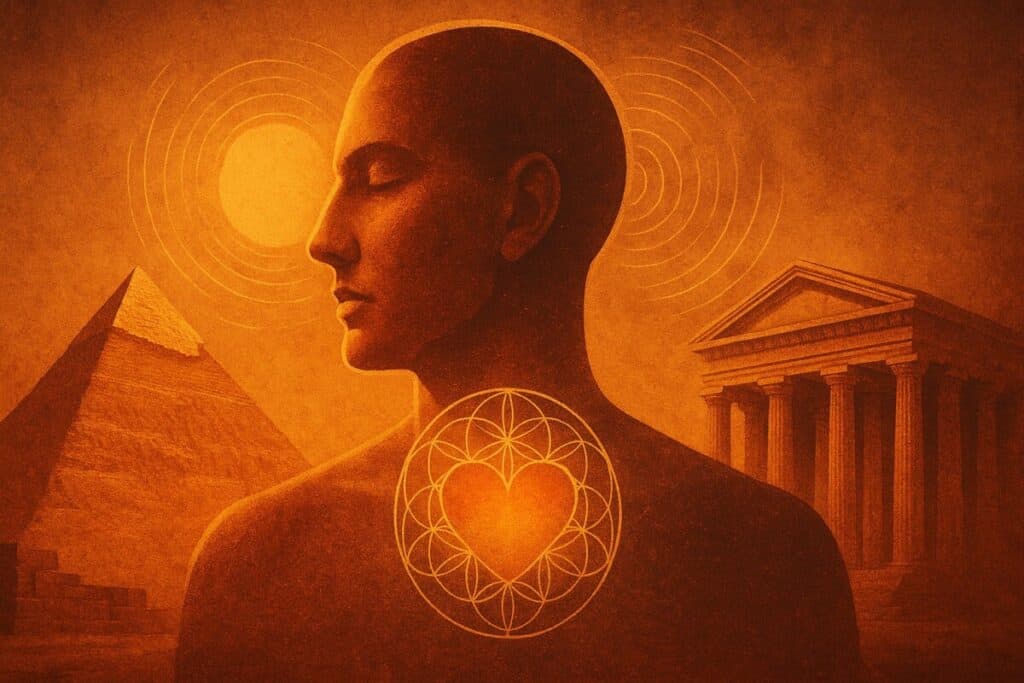
To ancient civilizations, gods weren’t “up there.”
They were emotional and elemental intelligences — personified so humans could relate, revere, and realign with them.
- To worship Ra was to summon solar clarity, rhythm, and life-giving order.
- To invoke Sekhmet was to awaken righteous fury — the fire of purification.
- To bow to Ma’at was to surrender to balance, justice, and cosmic truth.
These weren’t symbolic stories.
They were neuro-emotional alignments, encoded into temples, rituals, and the structure of the state.
Here’s how it mapped out:
| Emotion | Archetype / Deity | Civilizational Function |
|---|---|---|
| Rage, Purification | Sekhmet (Egypt), Ares (Greece) | War readiness, cleansing, moral outrage |
| Desire, Fertility | Aphrodite, Isis | Connection, creation, diplomacy |
| Truth, Justice | Ma’at | Moral law, legitimacy, balance |
| Logic, Order | Thoth, Apollo | Measurement, governance, clarity |
| Rebellion, Fire | Prometheus | Innovation, awakening, challenge of authority |
To worship wasn’t passive belief — it was participatory attunement.
You weren’t praying to a god.
You were tuning yourself to a frequency — and that frequency shaped your behavior, your society, your system.
“To worship a god was to encode your nervous system with its frequency.”
— Jan Assmann, Egyptologist and cultural memory theorist
Today, we no longer call them gods.
We call them values, principles, or narratives.
But make no mistake — the emotional circuitry is still running.
Only now it’s fragmented.
Ungrounded.
And often hijacked by systems that exploit our emotions rather than help us integrate them.
Ritual Was the Original Emotional Code
Ancient rituals weren’t mere theatrics.
They were emotional software systems — coded through repetition, symbolism, and rhythm — that wired individual psyches into collective identity.
These were neuro-social algorithms, fine-tuned through generations:
- Chanting ⟶ breath entrainment, vagal tone activation, trance-state induction
- Movement & dance ⟶ limbic system regulation, mirror neuron mirroring, somatic anchoring
- Myth ⟶ archetypal narrative scripting, episodic memory encoding
- Offerings & sacrifice ⟶ behavioral commitment, emotional investment, value anchoring
Every ritual was a multi-sensory input system:
Input (symbol) → Processing (embodiment) → Output (emotional alignment)
Imagine this:
You’re walking barefoot through a temple corridor.
The stone is cool beneath your feet. Incense hangs thick in the air.
A priest chants in rhythm, his voice vibrating through the chamber.
Drums pulse, slow and steady — like a heartbeat that isn’t yours, but could be.
Your breath synchronizes. Your sense of time dissolves.
You are no longer a name. You are part of a field — a shared signal.
This was not performance. It was programming.
Emotionally, biologically, culturally.
“What you ritualize, you emotionalize.
What you emotionalize, you become.”
And though we call ourselves secular, the ritual code still runs —
just rebranded, digitized, and monetized.
Modern analogues:
- Rallies with call-and-response slogans
- National anthems sung in stadiums
- Product launches choreographed like ceremonies
- Social media loops built to trigger emotion + repetition
We didn’t stop doing ritual.
We just forgot we were still inside one.
🏛️ Temples Were Resonance Technology — Not Decoration
Pyramids. Ziggurats. Stone circles.
These were not monuments to ego.
They were frequency infrastructures — designed to amplify, tune, and stabilize the emotional energy of a civilization.
These weren’t built to be admired.
They were built to be felt.
- At Karnak, the acoustics were so precise, a single priest’s voice could echo as if the gods themselves were speaking.
- At Abu Simbel, the temple alignment was so exact that the sun illuminated Ramses’ face only on the days marking his birth and coronation.
- The Great Pyramid’s internal chambers suggest intentional acoustic resonance — capable of producing standing waves tied to the body’s own organ frequencies.
These weren’t structures. They were architectural tuning forks.
They worked by manipulating space, light, sound, and scale to evoke deep emotional states:
- Awe through verticality
- Humility through darkness and narrowing passages
- Transcendence through harmonic resonance and light at precise angles
Modern architecture continues to apply these same emotional principles — often unconsciously:
- Cathedrals harness verticality and reverb to draw the spirit upward
- Stadiums concentrate sound and movement to incite mass euphoria
- Shopping malls use lighting, scent, and soundscapes to influence behavior and time perception
But the sacred intent is gone.
What was once reverence… is now monetization.
🌀 Systemic Ripple
When architecture is emotionally resonant, it becomes more than shelter.
It becomes a conductor of coherence — influencing law, commerce, ritual, belief, and belonging.
Temples shaped cosmologies.
City layouts echoed celestial order.
Markets were placed beside altars.
Power flowed through sacred space — not just geopolitics.
In that sense, emotion was never just felt.
It was embedded into stone.
And what you embed in stone, you embed in time.
Mass Hypnosis Is Just Group Emotion in Sync
Let’s remove the mystery.
What we often call “mass hypnosis” isn’t sorcery — it’s systemic emotional synchronization, grounded in the biology of group psychology and the structure of ritual.
Across cultures and centuries, leaders, priesthoods, and revolutionary movements alike have leveraged this principle. It’s not unique to one ideology or time period — it’s a human pattern.
Rituals, myths, and spectacles were always more than belief systems.
They were neuro-social entrainment mechanisms, carefully calibrated to align the emotional and behavioral rhythms of the collective.
| System | Effect | Ancient Tool |
|---|---|---|
| Mirror neurons | Emotional mimicry | Collective chanting, synchronized movement |
| Oxytocin | Group bonding & loyalty | Shared sacrifice, communal rites |
| Amygdala | Fear-based focus & threat response | Judgment myths, scapegoating, divine punishment |
| Prefrontal Cortex Inhibition | Susceptibility to narrative absorption | Rhythmic repetition, awe, spectacle, incense |
“Mass hypnosis doesn’t need a sorcerer. Just the right emotional sequence and enough repetition.”
— Dr. Daniel Goleman, psychologist
In anthropological terms, this is liminality — the threshold state in a ritual where ordinary identity dissolves, and the participant is reshaped by shared symbols and rhythms.
In sociological terms, this is the collective effervescence described by Émile Durkheim — a high-intensity state where individual identity gives way to group cohesion.
Ancient festivals, death rituals, war processions, and fertility rites were designed not just to honor deities — but to engineer alignment, both emotional and institutional.
These were cultural control systems — sacred, yes, but also strategic.
And though the aesthetics have changed, the systems remain.
Today’s equivalents?
- Breaking news banners
- National crisis speeches
- Viral campaigns
- Pop concert stagecraft
- “Trending” hashtags functioning as symbolic mass chants
We are still entraining.
Still synchronizing.
But too often without the cultural guardrails of sacred intent, moral alignment, or mythic context.
Modern Politics Is Just Rebranded Polytheism
Strip away the soundbites, and modern politics looks eerily familiar to any student of comparative religion or ancient governance.
We haven’t stopped worshipping gods — we’ve simply replaced sacred names with secular ideals, and temples with institutions.
| Ancient God | Modern Equivalent | Emotional Function |
|---|---|---|
| Prometheus | Freedom | Disruption, fire, progress |
| Ma’at | Security & Order | Justice, harmony, balance |
| Apollo | Technocratic Progress | Logic, light, control |
| Horus | Identity | National pride, visibility |
| Sekhmet | Vengeance / Purity | Righteous anger, cleansing |
- Political movements act as modern priesthoods, interpreting the will of their chosen ideal
- Campaigns and rallies mirror ritualistic gatherings, complete with chants, symbols, and sacred colors
- Media cycles create modern myth repetition, forging narratives that define moral boundaries and heroic struggles
“The gods never left — they became moods, hashtags, policies, and parties.”
This isn’t metaphorical — it’s structural.
In ancient Mesopotamia, the king was legitimized through divine sanction. In modern democracies, leaders seek legitimacy through emotional alignment with abstract ideals — liberty, safety, prosperity, equality.
Each party, each movement, offers its own pantheon — and demands its own rituals of allegiance.
We vote not just with ballots — but with sentiment, tribal identity, and ritual performance.
The real question isn’t whether we’re worshipping.
The question is:
Are we choosing our gods consciously — or are they choosing us through repetition, spectacle, and unexamined emotion?
Because when we stop recognizing the architecture of belief, we become vulnerable to it.
And what was once sacred storytelling becomes subtle manipulation.
📉 Collapse Begins With Emotional Misalignment — Long Before the Numbers Show It
From a macroeconomic perspective, collapse rarely begins with GDP contraction or sovereign default.
By the time markets register a crisis, the deeper foundations have already eroded.
Ancient Egypt captured this reality in its philosophy of Ma’at — the principle of sacred order, harmony, and truth that governed everything from law and economy to the Nile’s cycles.
When rulers violated Ma’at — when corruption outpaced accountability, and truth gave way to propaganda — the result wasn’t just spiritual. It was systemic.
The civilization moved into Isfet: a state of chaos, deception, and disintegration.
Ma’at was more than mythology.
It was the original model of macro-systemic balance — a blueprint of interdependence between environment, emotion, governance, and legitimacy.
In modern terms, we can frame this in macro strategy as a multi-variable fragility model:
- When public trust deteriorates, capital no longer flows efficiently through the system (credit tightens, investment halts).
- When narrative coherence breaks down, political gridlock and populism surge — impairing institutional response.
- When truth becomes subjective, markets become volatility-driven rather than fundamentals-based.
- When emotion is manipulated instead of honored, you get sentiment bubbles, mass psychosis, and panic cycles.
In Dalio’s Big Cycle terms, this is the “late-stage empire” dynamic:
internal disorder, declining returns on capital, increasing polarization — all symptomatic of a deeper emotional misalignment between people and power.
This isn’t philosophy. It’s historical pattern recognition:
- The fall of Rome began not with invasion — but with loss of civic virtue and institutional trust.
- The French Revolution ignited as emotional alienation met economic injustice.
- The 2008 crisis wasn’t just subprime debt — it was collective overconfidence, regulatory capture, and mass denial.
Macro Metaphor: Detuning the Orchestra
Think of a civilization as an orchestra — capital flows, policies, institutions, and people all playing different instruments.
One player off-tempo? There’s tension.
But if the conductor loses credibility — if each section starts playing to its own rhythm, chasing its own reward signal — the entire structure dissolves into noise.
Collapse, then, is not a single event. It’s a slow-motion detuning of the societal ensemble —
until no melody remains, only feedback.
Core Insight for Macro Strategists:
Emotional coherence is an early indicator of macro resilience.
Once lost, no monetary or fiscal policy can restore it without a narrative realignment — a return to shared truth, trust, and purpose.
The next major market risk isn’t just inflation or debt.
It’s a crisis of meaning — a mispriced emotional dissonance embedded in the system’s social architecture.
In ancient terms, it’s a violation of Ma’at.
In modern terms, it’s a misalignment of incentives, narratives, and emotional capital.
Same signal.
Different vocabulary.
Same eventual outcome — unless corrected in time.
Final Insight: Emotional Sovereignty Is the New Macro Discipline
If monetary policy governs liquidity, and fiscal policy shapes flow… then emotional resonance is the gravity field that determines whether a civilization holds together — or fragments.
We are trained to track CPI, bond yields, and interest rates.
But beneath those metrics lies something older and more powerful:
What a society chooses to feel — and how often it repeats that feeling.
Ancient leaders understood this.
They encoded emotional frequency into temples, rituals, symbols, and seasonal rites — not for control, but for coherence.
It was emotional risk management long before central banking existed.
Today, we’ve lost that intentionality.
We’ve optimized for growth but not for meaning.
We’ve scaled information but neglected integration.
We’ve manipulated sentiment for profit — but failed to manage emotional capital as the long-term asset class it truly is.
Here’s the macro truth:
The next collapse won’t just be fiscal.
It will be a collapse in emotional credibility — a mispriced crisis of trust, purpose, and identity.
No stimulus package can fix that.
Only a re-alignment of values and narrative truth can.
So the real hedge isn’t gold, Bitcoin, or foreign equities.
It’s the internal infrastructure of emotional sovereignty:
The ability to choose your resonance in the midst of volatility.
Final Reflection:
What gods are you tuned to?
What emotions are you investing in — by repetition, by attention, by belief?
Because just like capital compounds over time…
so do emotions.
They shape decisions.
They drive systems.
They build — or break — civilizations.
And in this cycle, the only lasting alpha…
is coherence.
**Thanks For Reading — Seriously**
If you made it this far, we genuinely appreciate your time. The Conscious Vibe exists to ask better questions, explore deeper ideas, and share curiosity that might spark a new idea or a new perspective.
If you found this article helpful, let us know and if this sparked something in you — share the vibe.
You may have noticed that there are no ads here. No popups. And we like it that way.
If you feel like donating to support more informative thought provoking ideas and information, we sincerely appreciate it !!
Check out our donation page to help Support Conscious Vibe
It helps cover servers, admin tools, and pretty much keeps the lights on around here.