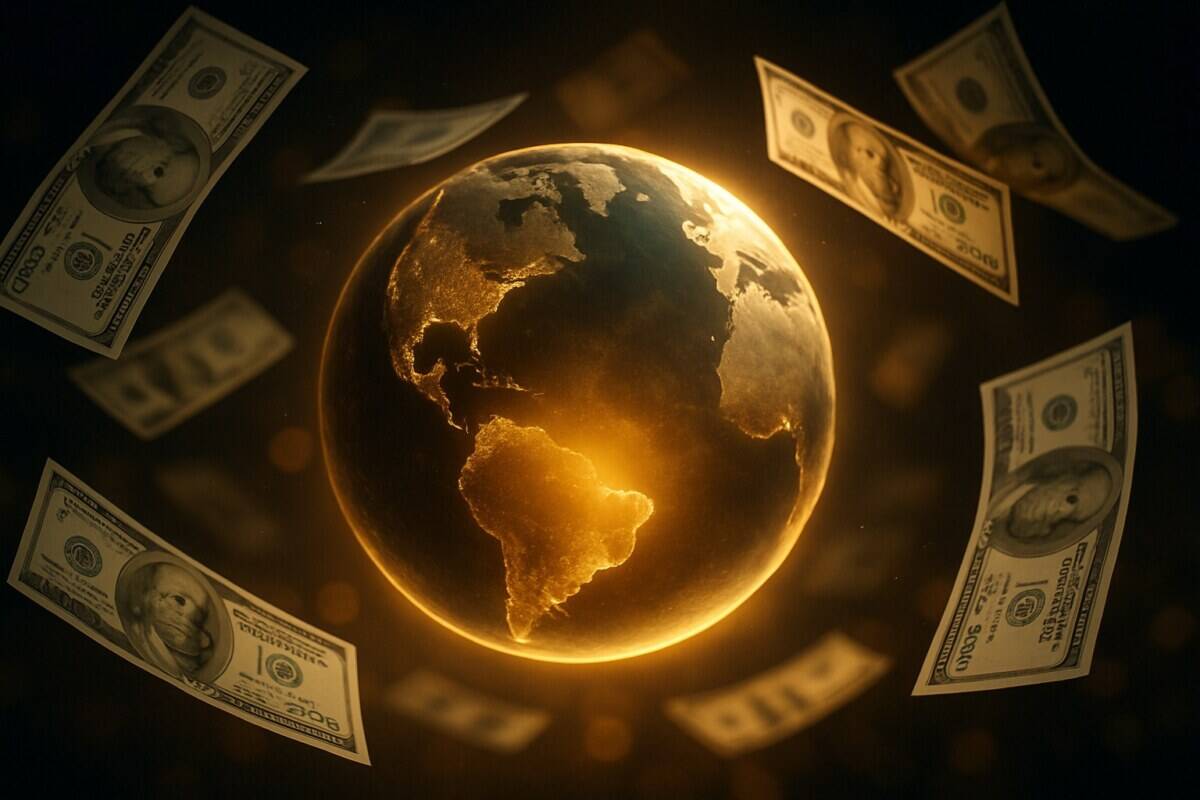
The Death of the Petrodollar: How the Collapse of Oil-Backed Money Is Rewiring the World
I. The Petrodollar: The Monetary Empire You Were Born Into But Never Saw
You weren’t born into a gold standard.
You were born into something stranger — a belief system built on barrels and bombs.
For the last fifty years, the U.S. dollar didn’t dominate the world because it was the best currency.
It dominated because the world’s most valuable resource — oil — could only be bought with it.
This system wasn’t a treaty.
It wasn’t voted on.
It wasn’t debated in your college economics class.
It was engineered behind closed doors in 1974, when the United States made a quiet deal with Saudi Arabia:
“Price your oil in dollars, and we’ll protect your regime — with weapons, with warships, with silence.”
And with that, the petrodollar system was born.
From that moment on, every nation had a choice:
Obey the system, or get locked out of the energy that runs civilization.
The U.S. didn’t need gold anymore. It had oil.
And oil, priced exclusively in dollars, became the new foundation for global finance, global trade, and global control.
You couldn’t redeem dollars for oil like you could with gold.
But you couldn’t access oil without them.
That made the dollar sacred not because it was stable — but because it was required.
And for 50 years, this invisible scaffolding decided:
- Who got rich
- Who got sanctioned
- Who got bombed
- And who got bailed out
But systems built on enforced belief always meet their reckoning.
Not in fire — but in fragments.
Not in headlines — but in quiet exits.
And now, the petrodollar isn’t collapsing — it’s unraveling.
II. The Dollar Was the Oxygen. Oil Was the Spark. Debt Was the Flame.
The genius of the petrodollar wasn’t that it forced the world to use U.S. dollars.
It’s that it made the world want to — or rather, need to — just to keep breathing.
It worked like this:
- Countries needed U.S. dollars to buy oil — their lifeline to growth, mobility, and industrial survival.
- To get dollars, they exported cheap goods to the U.S. — shoes, phones, microchips, dreams.
- The dollars they earned were parked in U.S. Treasuries — funding America’s debt machine.
- That debt financed military dominance, consumerism, and global financial entanglement.
And so the loop fed itself — quietly, endlessly.
“The dollar became the oxygen of global trade. And the U.S. became the only one with the match.”
This wasn’t just economics.
It was a planetary feedback loop:
- Oil → Dollars
- Dollars → Exports
- Exports → Surpluses
- Surpluses → U.S. Bonds
- Bonds → Guns, iPhones, and 11 aircraft carrier strike groups
The U.S. could run massive deficits and fund limitless military campaigns — not because it was productive, but because it controlled the monetary plumbing of the planet.
📊 Data Snapshot:
As of 2022, over 80% of global oil sales were still denominated in U.S. dollars (IMF, 2023).
🧠 Core Pattern: The petrodollar system turned every oil barrel into a vote for the dollar, every export into debt service, and every central bank into a silent partner of empire.
But systems like this don’t last forever.
Not because the math fails.
But because the trust — and the obedience — eventually erodes.
III. The Fracture Begins: Saudi Arabia Quietly Steps Off the Throne
Empires rarely fall with a bang.
They slip. Quietly. Deliberately. With deniability.
And in 2024, Saudi Arabia made its first audible slip.
It let JECOR dissolve — the 50-year economic commission that symbolized the sacred alignment between the House of Saud and Washington.
And then it did something even more heretical:
It accepted Chinese yuan and Indian rupees in oil trade deals — breaking the unspoken commandment of global finance: Thou shalt price oil in dollars.
📉 Within 24 months, it also reduced its U.S. Treasury holdings from $180 billion to $110 billion.
Most analysts shrugged. The headlines barely blinked.
But the system felt it. Because the petrodollar isn’t built on law — it’s built on choreography. And Saudi Arabia just changed the rhythm.
This wasn’t rebellion. It was realignment.
For the first time in half a century, the world’s largest oil exporter said, We’re no longer betting our survival on the dollar alone.
Why?
Because the world is changing:
- China is now Saudi’s largest oil customer.
- The U.S. is producing more of its own oil than it imports.
- The petrodollar deal made sense in 1974 — but in 2024, it’s a liability.
And beneath all of this is a deeper truth:
IV. What Most People Miss: The Petrodollar Was Never About Oil — It Was About Obedience
Oil was just the medium.
Control was the product.
When oil was priced exclusively in dollars, the U.S. didn’t have to earn its currency’s dominance — it only had to enforce it.
And enforce it, it did.
- When Iraq proposed selling oil in euros, it faced invasion.
- When Libya floated a gold-backed pan-African currency, it faced regime change.
- When Iran developed non-dollar trade platforms, it was sanctioned into isolation.
This wasn’t conspiracy. It was monetary empire management.
As former U.S. Treasury Secretary John Connally once said:
“The dollar is our currency — but it’s your problem.”
The problem now?
The world is solving that problem. Not with declarations — but with diversification.
Not with revolution — but with silent exits from a story no longer serving.
🔍 Systemic Ripple: Every time a country settles oil in yuan or rupees, it’s not just a trade. It’s a vote against dollar obedience — and a signal that the world is rebalancing from enforced belief to voluntary alignment.
And Saudi Arabia, long the high priest of the petrodollar faith, has just stepped off the altar.
V. Enter Gold, Bitcoin, and XRP — Not Replacements, But Escape Routes
When trust in the gatekeeper erodes, the world starts looking for new exits.
Every monetary system is built on an invisible foundation: belief.
Belief that the currency is sound.
Belief that the issuer is credible.
Belief that tomorrow, your money will still mean something.
But when belief fades — not overnight, but drip by drip — people and nations don’t wait for permission.
They start building side doors.
Here are three:
🟡 Gold — The Memory of Value
Gold isn’t just a commodity.
It’s a sovereign memory device — a collective anchor for civilizations who’ve seen fiat fail before.
In 2023, central banks accumulated over 1,100 tonnes of gold, the highest in modern history (World Gold Council).
Not because they want to trade it — but because they don’t trust the future of the dollar-based system.
Gold is:
- Neutral
- Borderless
- Resistant to inflation, politics, and manipulation
It doesn’t yield. It doesn’t move fast. But it doesn’t lie.
📌 Gold isn’t speculative. It’s ancestral trust in metallic form.
🟠 Bitcoin — The Stateless Firewall
Bitcoin was born from crisis — not just economic, but epistemic.
It’s not controlled by any nation. It doesn’t require banks. It doesn’t inflate to serve politicians.
El Salvador adopted it as legal tender.
Nigeria, Turkey, and Argentina are using it to escape collapsing fiat.
Bitcoin is:
- Scarce (21 million units)
- Transparent (open ledger)
- Incorruptible (rules without rulers)
It’s not just money. It’s digital sovereignty, embedded in math.
As central banks experiment with surveillance-based CBDCs, Bitcoin becomes the freedom layer — a hedge against programmable obedience.
🟢 XRP — The Neutral Bloodstream of Global Value
XRP doesn’t compete with currencies. It connects them.
Built for cross-border settlement, XRP offers:
- Near-instant transaction speed
- Minimal fees
- Interoperability with banks, remittance firms, and stablecoins
It’s already used by RippleNet clients across dozens of corridors — from Japan to the Philippines to South America.
XRP isn’t the coin. It’s the plumbing, the circulatory system for a future where no single currency dominates — but many must talk.
Core Truth: These Aren’t Just Assets — They’re Pressure Valves
When centralized systems tighten control, complexity doesn’t collapse.
It escapes.
It routes around.
It finds coherence elsewhere.
These assets aren’t replacing the dollar. They’re revealing where belief is flowing instead.
VI. Is the Dollar Dead? Not Yet — But It’s No Longer Divine
Let’s be clear:
- 58% of global reserves are still held in USD (IMF, 2023).
- 88% of foreign exchange trades involve the dollar.
- Most oil is still priced in USD.
So no — the dollar isn’t collapsing.
But it’s no longer inevitable. And that’s more dangerous.
What Most People Miss:
The dollar doesn’t need to vanish to lose power.
It just needs to stop being mandatory.
And that’s already happening:
- Trade routes are regionalizing.
- New currency agreements are bypassing USD.
- Alternatives are interoperable and programmable.
The empire isn’t dying with a bang. It’s dissolving with a thousand quiet decisions to exit.
This isn’t collapse. It’s decentralized erosion — and it’s already in motion.
VII. Final Insight: This Was Never Just About Money — It Was About Meaning
The petrodollar is not just a financial agreement ending.
It’s a civilizational contract dissolving — a contract that said one empire could set the value of everything, and everyone else would align or be excluded.
For decades, we didn’t question it.
We built our economies, our politics, our military strategies, and our beliefs around this invisible center of gravity.
But something profound is shifting.
Gold is returning as memory.
Bitcoin is emerging as code-bound sovereignty.
XRP and others are rebuilding the rails of value — not from ideology, but from interoperability.
This isn’t just economic evolution.
It’s psycho-political emancipation from enforced trust.
The U.S. dollar won’t vanish.
But its myth of inevitability — the quiet agreement that “this is just how the world works” — has already died.
We’re not watching a collapse.
We’re witnessing a rewriting of reality — a shift from permission to participation, from coercion to coherence.
The systems that rise next won’t ask to be believed.
They’ll be chosen, verified, and earned — not just in markets, but in minds.
**Thanks For Reading — Seriously**
If you made it this far, we genuinely appreciate your time. The Conscious Vibe exists to ask better questions, explore deeper ideas, and share curiosity that might spark a new idea or a new perspective.
If you found this article helpful, let us know and if this sparked something in you — share the vibe.
You may have noticed that there are no ads here. No popups. And we like it that way.
If you feel like donating to support more informative thought provoking ideas and information, we sincerely appreciate it !!
Check out our donation page to help Support Conscious Vibe
It helps cover servers, admin tools, and pretty much keeps the lights on around here.