Beyond the Headlines: Investing & Understanding: How Earth’s Climate Works
Whenever climate change comes up, it often sparks debate, division, or discomfort. But the real issue isn’t whether the climate is changing—it’s how it’s changing, why, and what we should do about it.
Earth’s climate has always evolved—tilting, wobbling, and cycling between ice ages and warm periods over tens of thousands of years. These shifts are driven by natural forces: solar cycles, orbital mechanics, volcanic activity, and the chemistry of our atmosphere.
At its core, climate is about balance—between the energy Earth receives from the sun and the heat it radiates back into space. Greenhouse gases like carbon dioxide and methane naturally trap some of that heat, making life possible. But when this balance is disrupted—especially rapidly—systems begin to strain.
The science is clear: today’s changes are faster and more extreme than anything seen in at least 800,000 years. Human activity is now a major force in that equation.
In this article, we’ll step past the noise to explore how Earth’s climate really works, what the data tells us, and how we can respond—consciously, collectively, and with clarity.
Let’s begin.
The Ancient History of Climate Change: Earth’s Natural Rhythms
Earth’s climate has never been static. Over its 4.5-billion-year history, our planet has experienced profound shifts—ice ages, tropical epochs, and everything in between. These climate fluctuations follow long-term cycles driven by natural forces.
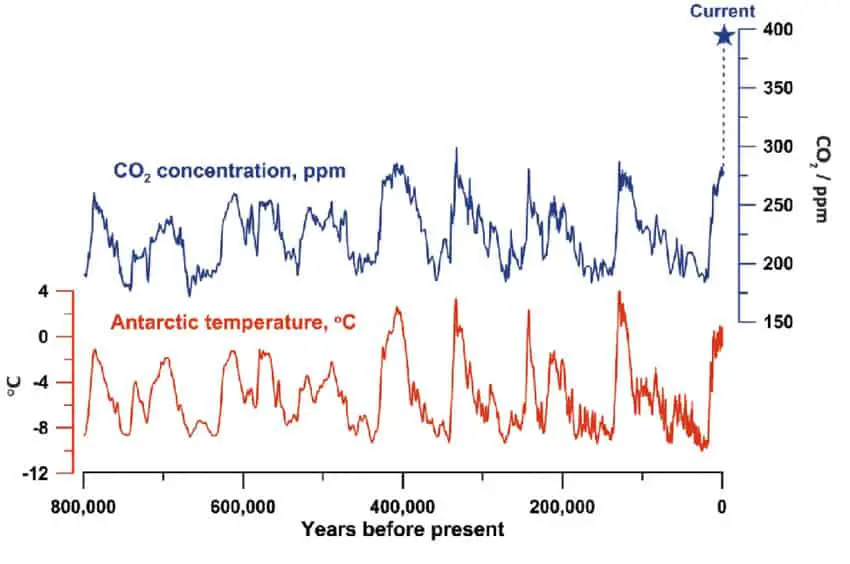
One of the most consistent patterns is the ~100,000-year cycle between glacial (ice age) and interglacial (warmer) periods.
Evidence From the Ice: 800,000 Years of Climate Records
French climatologist Jean Jouzel and his team revealed this deep-time climate rhythm by analyzing Antarctic ice cores. These frozen archives stretch back more than 800,000 years, capturing snapshots of Earth’s atmospheric composition and temperature across time.
The conclusion? Climate change is a natural part of Earth’s behavior, driven by a complex blend of planetary forces.
What Drives These Natural Climate Cycles?
Earth’s long-term climate patterns are influenced by:
- Orbital shifts (Milankovitch cycles)
- Axial wobble and tilt
- Solar radiation changes
- Volcanic activity
- Natural greenhouse gas fluctuations
- Ocean-atmosphere interactions
These systems have worked together for millions of years to maintain a dynamic balance. But the key question today isn’t whether climate changes naturally—it’s how much of today’s change is still natural, and how much is being driven by us.
Milankovitch Cycles: Earth’s Long-Term Climate Clock
In 1924, Serbian climatologist Milutin Milanković published his landmark book Climates of the Geological Past, outlining how variations in Earth’s orbit and tilt influence long-term climate patterns. These are now known as the Milankovitch Cycles—and they affect how much solar radiation reaches different parts of the Earth over tens of thousands of years.
Earth’s Changing Orbit
Roughly every 100,000 years, Earth’s orbit shifts between more circular and more elliptical. This alters the distance from the Sun and changes how much solar energy the planet receives—triggering glacial and interglacial periods.
Axial Tilt and Wobble
Earth’s axis is tilted at 23.4°, giving us our seasons. But this tilt shifts over a 41,000-year cycle. Simultaneously, a slow wobble called axial precession happens every ~26,000 years, changing the timing of the seasons.
“Axial precession makes seasonal contrasts more extreme in one hemisphere and less extreme in the other.” — NASA Climate
These natural variations impact Earth’s climate—but they do so slowly. What’s happening now is far faster.
The Greenhouse Effect: Earth’s Natural Thermal Blanket
The greenhouse effect is essential for life on Earth. It occurs when certain gases in the atmosphere trap heat from the sun, warming the surface to a livable temperature. Without it, Earth’s average temperature would be around -20°C (-4°F).
Atmospheric Composition
According to NOAA, Earth’s atmosphere is primarily:
- Nitrogen (N₂): 78%
- Oxygen (O₂): 21%
- Carbon dioxide (CO₂): ~0.035%
- Methane (CH₄) and other trace gases: < 1%
Even in trace amounts, greenhouse gases have a significant effect on global temperatures.
How the Greenhouse Effect Works
- Solar radiation reaches Earth and is absorbed by the surface.
- The surface re-emits energy as heat (infrared radiation).
- Greenhouse gases absorb and re-radiate this heat, warming the planet.
Major Greenhouse Gases and Their Impact
Carbon Dioxide (CO₂)
- Makes up ~76% of human-caused greenhouse gas emissions.
- Naturally absorbed and emitted by oceans, forests, and soil.
- Human activity—like burning fossil fuels and deforestation—adds CO₂ faster than the Earth can absorb it.
Daniel Rothman, MIT professor of geophysics, notes:
“The planet absorbs and emits about 100 billion tons of CO₂ annually—but human activity is tipping that balance.”
Methane (CH₄)
- Over 25 times more potent than CO₂ over a 100-year period.
- Produced by wetlands, rice paddies, cows, and fossil fuel extraction.
- Accounts for roughly 11% of the greenhouse effect.
Natural vs. Man-Made Carbon Sources
Understanding where greenhouse gases come from helps explain how the climate system works—and how it’s being altered.
Natural Carbon Sources
Land: Plant and Animal Decay
As plants and animals die, decomposition releases CO₂ into the air. These sources account for ~30% of the CO₂ in Earth’s atmosphere.
Ocean-Air Exchange
Covering 70% of Earth’s surface, the oceans act as carbon sinks:
- Marine life (like phytoplankton) absorbs CO₂ for photosynthesis.
- When these organisms die, their carbon sinks to the ocean floor.
- This process, known as the biological pump, helps regulate carbon—but it’s being strained.
🧪 Problem: Oceans absorbing more CO₂ leads to ocean acidification, harming coral reefs and marine ecosystems.
Human-Caused Carbon Emissions
Despite nature’s ability to absorb CO₂, human activities are adding more carbon than the Earth can manage.
Top Human Sources of Greenhouse Gases:
- Industry: 24%
- Agriculture / Land Use: 24%
- Electricity & Heat: 23%
- Transportation: 15%
- Buildings: 6%
- Other: 10%
“Greenhouse gas emissions generated by human activity exert extra pressure on what is otherwise a self-balancing Earth system.” — Beijing University, 2018
Ways Global Climate Is Measured
Understanding how scientists measure global climate is essential to grasping the reality and pace of climate change. Let’s explore the key methods used to track Earth’s climate system and how fast those indicators are changing today.
🌡️ Average Global Temperature
How It’s Measured
- Land-based weather stations
- Ocean buoys
- Satellite instruments
This provides a global picture of how much solar radiation Earth retains versus how much it emits as infrared heat.
What the Data Shows
- From the 1950s to 2020, global temperatures have risen steadily.
- In 2021 and 2022, a slight dip was observed, but overall, the long-term warming trend persists.
Rate of Change
- Natural glacial-to-interglacial warming: ~0.4–0.7°C per 1,000 years.
- Current warming (IPCC): ~20°C per 1,000 years.
- We are warming the Earth 20–50x faster than historical natural cycles.
🧊 The Size of Arctic Ice Sheets
How It’s Measured
- Satellite imagery
- Aerial surveys
- LIDAR
- Ice core drilling
- Visual documentation by scientists
Long-Term Trends
- Arctic sea ice has shrunk by an average of 2.5% per decade over the past 45 years.
- Greenland lost an average of 280 billion tons of ice per year (1993–2016).
- Today, that number is closer to 410 billion tons per year.
Rate of Change
- Historical melt occurred over thousands of years.
- Today, Arctic ice is retreating in just decades—an unprecedented pace.
- Wildlife and human systems are struggling to adapt to this speed of change.
🌊 Global Sea Level
How It’s Measured
- Tide Gauges: Instruments installed at coastal sites to measure sea height over time.
- Satellites: Use radar altimetry to measure sea surface height from space with precision.
What’s Happening
- Rising temperatures → melting glaciers + thermal expansion of ocean water → sea level rise.
- Sea level rise is now accelerating faster than at any point in the past 800,000 years.
Scientific Confirmation
Institutions like the Potsdam Institute for Climate Impact Research and Australian National University project continued acceleration unless major changes occur.
🔍 Summary of Climate Indicators
| Indicator | Natural Rate (per 1,000 yrs) | Current Rate | Notes |
|---|---|---|---|
| Temperature Increase | ~0.4–0.7°C | ~20°C | Human-driven, linked to CO₂ rise |
| Arctic Ice Loss | Over millennia | In decades | Historical loss is slow; current loss is exponential |
| Sea Level Rise | Thousands of years | Accelerating in real-time | Driven by both meltwater and ocean warming |
By understanding how these metrics are tracked—and how rapidly they’re changing—we can see climate change not as an abstract idea, but as a measurable, accelerating system shift that touches every part of our global ecosystem.
🌍 What Can We Do About Climate Change?
A Global Macro Approach to Climate Investment
In a world with limited time, capital, and global coordination, the question isn’t just “what should we do?”—it’s:
Where should we invest the next trillion dollars to maximize the impact on both human survival and climate stabilization?
🧠 Perspective 1: Maximize Lives Saved Per Dollar
Adaptation and public resilience projects often deliver the highest return in human lives saved—especially in vulnerable, lower-income regions already affected by climate events.
💰 Top Allocations (Per $1M Spent):
| Investment Type | Impact | Why It Works |
|---|---|---|
| Early Warning Systems | Save ~200–300 lives per storm or flood | Low cost, high lifesaving potential. Backed by UNDRR & World Bank. |
| Urban Cooling Projects | Reduce heatwave deaths by 20–70% | Simple infrastructure (shade, trees) with large impact. |
| Climate-Resilient Crops | Feed thousands, prevent famine | Improves agricultural yield under shifting weather patterns. |
| Disaster-Resilient Infrastructure | Prevents death/injury from flooding & storms | Greatest ROI in vulnerable coastal and floodplain regions. |
| Clean Cooking Technologies | Save lives from smoke + deforestation | Indoor air pollution kills nearly 4M/year, especially women & children. |
Conclusion: To save the most lives in the short term, investments in health, adaptation, and infrastructure resilience outperform decarbonization.
🌡️ Perspective 2: Maximize CO₂ Reduction Per Dollar
If our goal is to slow global warming and prevent long-term tipping points, mitigation investments (carbon avoidance and removal) deliver the most systemic impact—even if benefits take longer to materialize.
💰 Top Allocations (Tons CO₂ Avoided/Removed per $1M):
| Investment Type | Estimated CO₂ Reduction | Why It Works |
|---|---|---|
| Utility-Scale Wind & Solar | 600–2,000+ tons/year | Proven tech with scalable cost efficiency. |
| Methane Capture (Landfills & Ag) | 1,500–4,000 tons CO₂e/year | Methane is 25x more potent than CO₂ over 100 years. |
| Tropical Forest Preservation | 1,000–5,000 tons/year | Protects major carbon sinks in Brazil, Congo, Indonesia. |
| Direct Air Capture (DAC) | 100–500 tons/year (currently) | Expensive now, but scalable and tech-enabled future solution. |
| Grid Modernization & Storage | Indirect multiplier effect | Enables renewables to replace fossil baseload power. |
Conclusion: To stabilize global temperature, the most effective long-term investments focus on energy systems, land use, and carbon capture technologies.
Man Made or Natural, Either Way, Do We Ignore Climate Change?
From a macro investing lens, the smartest global strategy isn’t either/or. It’s both—and in proportion to the impact horizon.
4 Global Climate Investments: Impact and Strategic Value
Addressing climate change requires a multifaceted approach, integrating cutting-edge innovation with nature’s timeless wisdom. Below is a deep dive into the five most effective climate solutions, evaluated for both planetary impact and long-term strategic value—rooted in science, soul, and the systems thinking we need to evolve humanity’s path forward.
1. Decarbonize the Energy Backbone (Renewables + Storage)
What It Is: Transitioning from fossil fuels to renewable energy sources like solar, wind, hydro, and nuclear—backed by grid-scale storage.
- Pros:
- Massive Emission Cuts: Eliminates ~34% of global GHG emissions from the electricity and heat sector.
- Enables Systemic Electrification: A clean grid powers everything from cars to factories carbon-free.
- Cost Savings: Renewables are now the cheapest energy source in many regions, with solar and wind down ~90% in cost since 2010.
- Public Health: Cuts air pollution from coal and gas, improving respiratory health worldwide.
- Cons:
- Intermittency: Solar and wind are variable, requiring large-scale storage, grid flexibility, or backup systems.
- Land Use & Mining: Requires land and critical minerals like lithium, cobalt, and rare earths, raising sustainability and justice concerns.
- Recycling & Waste: End-of-life solar panels and turbine blades pose recycling challenges that must be planned for now.
Climate Impact Rating: 10/10
Strategic Value Rating: 10/10
2. Target Methane and Super-Emitters
What It Is: Dramatically cutting emissions of methane (80x more potent than CO₂ over 20 years) from fossil fuels, agriculture, and waste.
- Pros:
- Rapid Cooling: Cutting methane can reduce warming by ~0.3°C by 2040—an enormous short-term impact.
- Cost-Effective: Many fixes (leak detection, landfill capture, better rice and livestock practices) are low-cost or even net-positive.
- Air Quality: Reduces ground-level ozone and prevents ~250,000 premature deaths per year.
- Cons:
- Temporary Solution: Methane cuts buy us time but don’t solve long-term warming on their own.
- Hard-to-Regulate: Agricultural methane is diffuse and culturally sensitive to change.
- Tech Gaps: Satellite monitoring is improving but enforcement is weak in many regions.
Climate Impact Rating: 9/10
Strategic Value Rating: 9/10
3. Restore Natural Carbon Sinks (Forests, Wetlands, Soils)
What It Is: Regenerating Earth’s own life-support systems by restoring forests, wetlands, peatlands, and healthy soils—natural ecosystems that pull carbon out of the atmosphere and into the ground.
- Pros:
- Nature’s Climate Engine: With the right stewardship, natural sinks can remove up to 2–10 Gt CO₂ per year from the air.
- Whole-System Healing: Restores biodiversity, rain cycles, and Indigenous knowledge systems that have balanced ecosystems for millennia.
- Community Resilience: Protects against floods, drought, soil erosion, and water scarcity while building climate resilience from the ground up.
- Cons:
- Land & Equity Trade-offs: Restoring land at scale must balance food production, land rights, and ecological diversity.
- Impermanence Risk: Forests can burn, be logged, or degrade—releasing stored CO₂ without policy or legal protection.
- Saturation Ceiling: Even maximally restored, nature’s carbon sink capacity has a limit and can’t offset ongoing fossil emissions alone.
Climate Impact Rating: 8/10
Strategic Value Rating: 8/10
4. Electrify Everything (Transport + Industry)
What It Is: Phasing out fossil-fueled machines and replacing them with clean, efficient electric systems—from EVs and electric buses to heat pumps and industrial arc furnaces. This is the keystone strategy to decarbonize the modern world.
- Pros:
- Massive Decarbonization: Electrification can cut 8–12 Gt of CO₂ per year globally when powered by renewables—directly eliminating oil and gas combustion in vehicles, homes, and industry.
- Efficiency Revolution: EVs are 4–5x more efficient than gas cars, and electric heat pumps can reach 300–400% efficiency over gas boilers.
- Health + Urban Benefits: Electrifying cities reduces air pollution, asthma, cancer risk, and noise—all while enhancing public transit and energy independence.
- Cons:
- Upfront Costs & Equity: High initial investment for vehicles, infrastructure, and industrial conversion—must ensure equitable access and support for low-income regions.
- Grid Load: Doubling electricity demand requires unprecedented scaling of renewable energy and storage—or else “dirty electrification” becomes a risk.
- Resource Supply Chains: Demand for lithium, cobalt, and nickel may exacerbate environmental harm and geopolitical tensions without circular economies or better standards.
Climate Impact Rating: 9/10
Strategic Value Rating: 9/10
Top 4 Climate Adaptation Solutions to Save Human Lives
As climate change intensifies, proactive adaptation measures are crucial to protect vulnerable populations. The following strategies have been identified for their effectiveness in reducing climate-related fatalities and enhancing community resilience.
1. Relocate Communities from High-Risk Areas
What It Is: Implementing managed retreat by relocating populations and infrastructure away from areas prone to flooding, sea-level rise, and other climate hazards.
- Pros:
- Risk Reduction: Removes communities from harm’s way, significantly decreasing the likelihood of injury and death from climate-induced disasters.
- Long-Term Cost Savings: Reduces the need for repeated disaster response and infrastructure repairs in high-risk areas.
- Cons:
- Social Disruption: Relocation can lead to loss of community ties and cultural heritage.
- Economic Challenges: High upfront costs and potential loss of livelihoods tied to original locations.
Human Lives Impact Rating: 10/10
Strategic Value Rating: 9/10
2. Construct Climate-Resilient Housing
What It Is: Developing and retrofitting homes to withstand extreme weather events such as hurricanes, floods, and heatwaves.
- Pros:
- Enhanced Safety: Reduces fatalities and injuries during extreme weather events.
- Energy Efficiency: Incorporates sustainable designs that can lower energy consumption and costs.
- Cons:
- High Initial Investment: Significant costs associated with construction and retrofitting.
- Maintenance Requirements: Ongoing upkeep needed to ensure resilience features remain effective.
Human Lives Impact Rating: 9/10
Strategic Value Rating: 8/10
3. Implement Early Warning Systems
What It Is: Establishing systems to provide timely alerts about impending climate-related hazards, enabling proactive evacuation and preparation.
- Pros:
- Timely Evacuations: Allows residents to move to safety before disasters strike, reducing casualties.
- Community Preparedness: Encourages development of emergency plans and resources.
- Cons:
- Technological Limitations: Requires reliable technology and communication networks.
- Public Compliance: Effectiveness depends on residents heeding warnings and taking appropriate action.
Human Lives Impact Rating: 9/10
Strategic Value Rating: 9/10
4. Develop Climate-Smart Agriculture
What It Is: Adopting agricultural practices that enhance food security and resilience to climate impacts.
- Pros:
- Food Security: Ensures stable food supplies, reducing malnutrition and related health issues.
- Livelihood Protection: Supports farmers in maintaining income despite changing climate conditions.
- Cons:
- Knowledge Barriers: Requires education and training for effective implementation.
- Resource Constraints: Initial investments in new technologies and practices may be prohibitive for some farmers.
Human Lives Impact Rating: 8/10
Strategic Value Rating: 8/10
⚖️ Final Thoughts: Investing Capital With Climate Truth
Final Thoughts: Investing Capital With Climate Truth
In a world flooded with headlines, algorithms, and division, it’s easy to lose sight of the deeper truth: climate change isn’t just a crisis—it’s a mirror.
A mirror reflecting how we live, what we value, and how interconnected everything truly is.
We now understand Earth’s climate not as a static condition, but as a living, breathing system—cyclical, responsive, and sensitive to imbalance. We’ve seen that the forces shaping our climate span from cosmic rhythms to human combustion, from ancient tectonic shifts to the carbon in a single breath. We’ve also seen that the rate of change today is unprecedented in geological time—and that humanity has become a primary driver.
But with that power comes choice.
The science is no longer about whether the climate is changing, but how quickly we respond, and where we direct our energy, capital, and collective will.
🧠 If we want to stabilize the planet, we must decarbonize our energy systems, electrify the machines of modern life, protect nature’s lungs, and scale technologies that pull carbon from the sky.
❤️ If we want to protect human lives, we must adapt—relocating vulnerable communities, building resilient homes, designing smarter food systems, and preparing for storms before they strike.
💡 And if we want to evolve as a civilization, we must go beyond survival. We must realign our economies with ecology, our innovation with wisdom, and our growth with harmony.
This is not a choice between saving the planet or saving ourselves. It’s the same choice.
Every ton of carbon cut… every flood-prone family safely relocated… every tree restored… every community educated, cooled, protected, and empowered—that’s climate action.
That’s love in action.
Whether you’re an investor, an entrepreneur, a policymaker, or simply a conscious human being, the question isn’t whether you can make a difference—it’s how deeply you want to show up for the future.
Regardless of why, Earth’s climate is changing, why not adapt to our environment?
**Thanks For Reading — Seriously**
If you made it this far, we genuinely appreciate your time. The Conscious Vibe exists to ask better questions, explore deeper ideas, and share curiosity that might spark a new idea or a new perspective.
If you found this article helpful, let us know and if this sparked something in you — share the vibe.
You may have noticed that there are no ads here. No popups. And we like it that way.
If you feel like donating to support more informative thought provoking ideas and information, we sincerely appreciate it !!
Check out our donation page to help Support Conscious Vibe
It helps cover servers, admin tools, and pretty much keeps the lights on around here.